
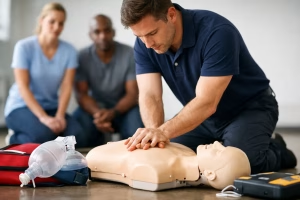
When someone collapses at work, on a sports pitch or in a public setting, the first few minutes matter more than any policy document ever will. Basic life support training prepares people to recognise a life-threatening emergency, start immediate care and support the casualty until ambulance crews arrive. For employers and individuals alike, that is not a box-ticking exercise. It is a practical skill set that can make the difference between hesitation and action.
In many workplaces across Scotland, the likely first responder is not a clinician. It is a colleague, supervisor, coach, instructor or member of staff who happens to be nearby. That is why basic life support sits in a useful middle ground. It is more focused than general awareness training, but it does not assume an advanced medical background. Done properly, it gives learners clear priorities under pressure and enough hands-on practice to act with confidence.
Contents
- 1 What basic life support training usually covers
- 2 Why this training matters in real workplaces
- 3 Who should take a basic life support course
- 4 What to look for in basic life support training
- 5 On-site or centre-based delivery
- 6 How often should training be refreshed?
- 7 Choosing a provider in Scotland
- 8 Basic life support training and compliance
What basic life support training usually covers
At its core, basic life support training is about preserving life by managing the most immediate threats. The exact content can vary slightly between providers and course levels, but most recognised programmes cover scene safety, primary assessment, checking responsiveness, opening the airway, assessing breathing, CPR and the use of an automated external defibrillator, or AED.
Training often includes how to place an unresponsive casualty in the recovery position when appropriate, how to identify agonal breathing, and how to communicate effectively with emergency services. Some courses also introduce choking management and role-specific considerations, particularly where staff may be caring for members of the public, children or vulnerable adults.
That breadth matters because emergencies are rarely neat. A casualty may not present exactly as described in a handbook. Good instruction helps learners understand the sequence of care, but also when to adapt. If the setting is a nursery, a gym, a forestry site or a marine environment, the context changes what a safe and realistic response looks like.
Why this training matters in real workplaces
There is a tendency to think of CPR as a rare skill used only in extreme cases. In practice, the value of basic life support training is wider than that. It improves emergency awareness across a team. Staff become quicker at spotting a deteriorating casualty, more confident in calling for help and better able to support emergency responders with clear information.
For employers, there is also a direct risk management benefit. In higher-risk sectors such as construction, manufacturing, equestrian activity, sport, outdoor education and marine operations, the consequences of delayed action can be severe. Even in lower-risk environments such as offices, receptions and retail premises, a cardiac arrest, collapse or choking incident can happen without warning.
That does not mean every workplace needs the same course. A small office with low hazards may need first aid coverage that differs from a remote outdoor team or a healthcare setting. The right decision depends on your risk assessment, staffing patterns, public access, travel time for emergency services and whether specific contractual or regulatory requirements apply.
Who should take a basic life support course
Basic life support is relevant to a wide range of roles because emergencies do not stay within one industry. It is suitable for workplace first aiders who need focused CPR and AED competence, but also for staff groups whose duties put them in regular contact with the public or with higher-risk activities.
Healthcare and care staff often require it as part of professional practice. Fitness professionals, sports coaches and community club volunteers benefit because collapse and sudden cardiac events can occur during exercise. Childcare settings may need a paediatric route rather than a standard adult-focused course, which is an important distinction. Likewise, those working in remote or specialist environments may need training that goes beyond basic life support into broader first responder or pre-hospital care content.
For individuals, the appeal is straightforward. Many people want practical emergency skills without committing to a long qualification. A short, well-structured course can provide that foundation and can later be built on if their role changes.
What to look for in basic life support training
Not all courses are delivered to the same standard, even when the subject heading looks similar. The first point to check is whether the training is accredited or aligned to recognised standards where required for your sector. Employers should be clear on whether they need informal awareness, regulated certification or a course designed to meet a specific professional framework.
The second point is realism. Basic life support should be taught as a hands-on skill, not as a slide presentation with a quick practical at the end. Learners need time with manikins, AED training devices and structured scenarios. Repetition matters because emergency response is partly about muscle memory. If people only hear the process once, they are less likely to perform it well under stress.
The third point is relevance to the working environment. A generic course may cover the mechanics of CPR, but sector-specific examples make the learning more usable. A forestry worker, nursery practitioner and leisure instructor do not face the same access issues, casualty profiles or escalation arrangements. Training should reflect that reality.
On-site or centre-based delivery
Delivery format can make a practical difference to attendance, consistency and cost. Centre-based courses suit individuals, small businesses and staff who prefer to train away from the workplace without interruption. They also work well when candidates from different organisations need the same qualification.
On-site delivery is often the better option for larger teams or for employers with operational constraints. It reduces travel time, allows more staff to be trained together and makes it easier to tailor examples to the actual setting. In some cases, it can also improve emergency planning because the trainer can relate the teaching to access points, AED locations and internal reporting procedures already in place.
There is a trade-off. On-site training needs suitable space, enough time set aside and proper release from normal duties. If staff are being pulled in and out of sessions, the quality of learning drops. Whichever format you choose, protected time and practical participation are essential.
How often should training be refreshed?
One of the most common questions from employers is how long basic life support training remains valid. The certified period will depend on the course and awarding body, but skill fade happens well before a certificate expires. CPR quality, AED confidence and recall of the response sequence can all decline if they are not practised.
That is why many organisations build in annual refreshers or short CPD updates, especially in healthcare, education, leisure and other public-facing roles. A formal requalification may only be due at set intervals, but lighter-touch refreshers help keep staff ready between full courses. This is particularly useful where there is low incident exposure. If people never use the skills, they need periodic rehearsal.
Choosing a provider in Scotland
For Scottish employers and individuals, convenience matters, but it should not be the only factor. A good provider offers recognised instruction, clear certification details, practical teaching and the flexibility to deliver either at a training centre or at client premises. It also helps if they understand the sectors they are training. Compliance-led workplaces do not need vague reassurance. They need clear course information and training that stands up to scrutiny.
Providers with broader first aid, fire safety and specialist emergency response experience can often give better guidance on where basic life support sits within a wider training plan. In some cases, it is the correct standalone course. In others, it should form part of a more comprehensive first aid arrangement. That is where an experienced training partner adds value.
For organisations looking at options across Scotland, https://SPR.training offers accredited courses from Airdrie as well as on-site delivery, which can be useful where teams need flexible access to regulated, role-specific training.
Basic life support training and compliance
It is worth being precise here. Basic life support training can support workplace preparedness, but it does not automatically replace a full first aid needs assessment or satisfy every legal requirement on its own. Employers must still assess hazards, workforce size, shift patterns, location and the likely nature of incidents.
In some settings, a basic life support course is entirely appropriate for the role. In others, staff will require emergency first aid at work, first aid at work, paediatric first aid or a specialist qualification with a broader clinical scope. The safest approach is to match the training to the actual risk rather than choosing solely on duration or price.
That same principle applies to individuals. The best course is not always the longest one. It is the one that gives you the right level of competence for the responsibilities you hold.
The strongest basic life support training does not just teach a sequence. It gives people the confidence to step forward, assess what is happening and start the right intervention without wasting valuable time. In any workplace or community setting, that readiness is never wasted.