
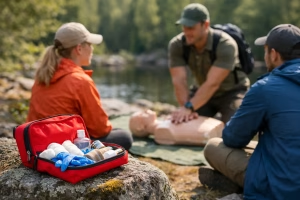
A twisted ankle on a woodland track is one thing. A serious bleed, asthma attack or head injury half an hour from vehicle access is something else entirely. That is why an outdoor first aid course needs to prepare people for more than routine incidents. In outdoor settings, help may be delayed, weather can complicate treatment, and decisions made in the first few minutes matter.
For employers, instructors and activity providers across Scotland, the right course is not simply about ticking a box. It needs to reflect the environment, the likely casualty group and the level of responsibility carried by staff on site. A coach running sessions in a local park, a forest school leader, and a forestry contractor working in remote ground may all need first aid training, but not necessarily the same training.
Contents
- 1 What an outdoor first aid course should cover
- 2 Who needs outdoor first aid training
- 3 How to judge the right outdoor first aid course
- 4 Outdoor first aid course options are not all the same
- 5 What employers should ask before booking
- 6 Training should match Scottish operating conditions
- 7 A practical standard, not a paper exercise
What an outdoor first aid course should cover
At a minimum, any outdoor first aid course should teach candidates how to assess an incident safely, manage an unresponsive casualty, deliver CPR, use an AED where available, and deal with common medical emergencies such as seizures, asthma, anaphylaxis and heart-related symptoms. Those are core first aid expectations in most settings.
Outdoor training becomes more useful when it goes further. Casualty management in the field often means coping with uneven terrain, cold, rain, poor communications and extended waiting times for ambulance support. That changes the practical emphasis. Learners should be trained to prioritise scene safety, protect the casualty from environmental exposure and monitor deterioration over a longer period than they might expect in a workplace corridor or reception area.
This is where course quality matters. A well-delivered programme does not treat the outdoors as a branding exercise. It builds realistic scenarios around injuries and illnesses that occur in countryside, activity and land-based environments. That may include fractures and sprains, catastrophic bleeding, hypothermia, heat-related illness, bites and stings, spinal concerns, and methods of casualty positioning when evacuation is difficult.
Who needs outdoor first aid training
The answer depends on role, risk and whether there is a governing body or insurer setting specific expectations. In practice, outdoor first aid training is commonly relevant for forest school staff, Duke of Edinburgh leaders, outdoor instructors, sports coaches, equestrian teams, countryside rangers, scouts and guides volunteers, estate workers and others supervising people away from immediate medical support.
For businesses, the question is usually whether standard workplace first aid is enough. Sometimes it is. If staff work outdoors but remain close to buildings, vehicles and prompt emergency access, a workplace qualification may meet the need. If they operate in woodland, on remote sites, around tools, or with children and groups in changing weather conditions, a more specific outdoor course is often the safer choice.
The same applies to self-employed instructors and freelance leaders. A certificate that looks acceptable on paper may still leave gaps in confidence if it was designed for indoor workplaces. Outdoor incidents tend to be less straightforward. Space, ground conditions, public access, weather and delayed handover all affect how first aid is delivered.
How to judge the right outdoor first aid course
Start with the environment. Ask where the learner actually works. A country park with mobile signal and quick ambulance access is not the same as remote forestry land or multi-activity venues spread over a large area. Then look at the casualty profile. Children, older adults, participants with known medical conditions and high-exertion groups each bring different considerations.
Next, consider the hazards involved. If the role includes saws, blades, campfires, water, animals, manual handling or vehicle movements, the training should reflect that level of risk. It is also worth checking whether the course includes enough practical time. First aid is a hands-on skill. People need to rehearse assessments, CPR, recovery position, bleeding control and scenario management under light pressure, not just listen to a presentation.
Accreditation matters too, particularly for employers and regulated sectors. A recognised qualification gives assurance that course content, assessment and certification have been structured properly. It also helps when you need to evidence competence to clients, schools, local authorities or insurers. That does not mean every organisation needs the longest available course, but it does mean the training should be credible, current and appropriate to the job.
Outdoor first aid course options are not all the same
This is where many buyers get caught out. Two courses can carry similar names while offering very different depth. Some are short awareness sessions designed to build confidence for low-risk activities. Others are regulated qualifications with formal assessment and a stronger focus on emergency response, casualty monitoring and real incident management.
Duration is often a clue, though not a guarantee. A one-day course may be enough for some lower-risk roles or as part of a governing body requirement. A two-day course usually allows more time for practical scenarios, environmental injuries and casualty care over extended periods. The right choice depends on the risk assessment, not on which course is quickest to complete.
Delivery format matters as well. Open courses suit individuals and small teams who need a place on a scheduled date. On-site delivery can be more effective for employers, because examples and scenarios can be tailored to the actual work environment. A forestry team, for instance, will benefit from different exercises than a school staff group using nearby woodland for outdoor learning.
What employers should ask before booking
A course description should tell you who the training is for, what certification is awarded, how long it lasts and what key subjects are covered. If that information is vague, ask more questions. You need to know whether the content aligns with your risk profile rather than assuming that any course with the word outdoor will do.
It is sensible to ask whether the trainer has operational experience relevant to the audience, whether the practical element is scenario-based, and whether certification meets insurer or organisational requirements. Employers should also check renewal periods and whether annual refreshers would be advisable. In some roles, waiting until the certificate expires is not the best approach. Skills fade, especially if incidents are infrequent.
There is also a staffing point to consider. If your operation runs over multiple locations, shifts or activity groups, one qualified first aider may not provide suitable cover. Training needs to match how the service is actually delivered. Compliance is part of the picture, but resilience matters as much.
Training should match Scottish operating conditions
Scotland presents its own practical realities. Weather can change quickly, daylight hours vary sharply through the year, and rural access can be limited. Even teams working relatively close to towns may face delayed response times depending on terrain and exact location. A useful outdoor first aid course should acknowledge those factors rather than relying on generic examples.
That is particularly relevant for land-based industries, outdoor education and community activity providers. Candidates need to think about casualty shelter, communication plans, access points for emergency services and how to manage a group while treating one injured person. Those are not niche details. They are common operational issues in real incidents.
Providers delivering across Scotland should also understand that convenience affects compliance. If training is hard to access, bookings get delayed and refreshers slip. That is why many organisations prefer a provider that can deliver either at a training centre or on client premises, depending on team size and location. For businesses balancing rotas, travel and operational demands, flexible delivery is often the difference between training planned and training completed.
A practical standard, not a paper exercise
The best outdoor first aid course gives learners a clear framework under pressure. It helps them assess quickly, act safely and manage the casualty until the next stage of care arrives. It should also leave them with a realistic understanding of their role. First aiders are not replacing ambulance clinicians, but in remote and outdoor settings they may need to do more, and for longer, than they would in a typical workplace incident.
For that reason, buying on price alone is rarely the best decision. The cheaper course may still be adequate for low-risk use, but where staff supervise groups outdoors or work in isolated ground, depth and relevance count. Good training reduces hesitation, improves decision-making and supports safer operations overall.
For organisations and individuals looking for accredited, sector-relevant delivery in Scotland, SPR Training provides practical options through its Airdrie training centre and on-site courses across the country. The key is to choose training that fits the real environment, not the label on the certificate.
If your team may need to keep someone safe until help can reach them, the right course is the one that prepares them for that exact moment.