
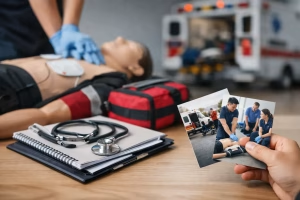
A one-day first aid certificate and a proper pre-hospital qualification are not the same thing. That matters when your team may need to manage catastrophic bleeding, maintain an airway, use oxygen, or keep a casualty stable until ambulance crews arrive.
For some roles, standard workplace first aid is enough. For others, it leaves a gap between what the risk demands and what staff are trained to do. That is where pre-hospital care courses come in. They are designed for people who may need to respond to more serious incidents in higher-risk settings, with training that goes beyond the basics and reflects what happens on the ground.
Contents
- 1 What pre-hospital care courses are for
- 2 Who should consider pre-hospital care courses
- 3 How to judge the right course level
- 4 What good pre-hospital care training should cover
- 5 Accreditation and compliance matter
- 6 Open course or private delivery?
- 7 When a shorter specialist course makes sense
- 8 Choosing a provider in Scotland
What pre-hospital care courses are for
Pre-hospital care courses prepare learners to assess, manage and monitor casualties before they reach hospital. In practice, that means structured emergency care in workplaces, public settings, remote environments, events, sport, outdoor activity and other situations where immediate clinical support is not yet on scene.
The difference is not just extra content. It is the level of decision-making involved. Learners are usually expected to recognise deterioration, prioritise treatment, communicate clearly during handover and work within a defined scope of practice. Good training focuses on practical application rather than theory for its own sake.
For employers, this often comes down to risk profile. A low-risk office may only need first aid at work cover. A construction site, forestry team, close protection operation, event crew or sports environment may require staff with wider emergency response capability. If the likely incidents include major trauma, environmental exposure or delayed access to ambulance support, pre-hospital training becomes much more relevant.
Who should consider pre-hospital care courses
These courses are not only for ambulance staff or clinical professionals. They are often a good fit for people working in roles where the first few minutes make a real difference and where hazards are more complex than minor cuts and fainting episodes.
That can include security teams, event medical staff, sports coaches, personal trainers, outdoor instructors, forestry workers, marine personnel, community responders and employers with higher-risk operational sites. They also suit experienced first aiders who need to build on an existing certificate with more advanced casualty management skills.
The right level depends on what the learner is expected to do. Someone acting as a workplace first aider with occasional exposure to higher-risk activities may need a different course from someone providing regular event cover or supporting remote operations. The point is not to collect certificates. It is to match the qualification to the actual environment, likely casualties and expected response time of emergency services.
How to judge the right course level
The most common mistake is choosing a course because the title sounds advanced, rather than because it suits the role. A better way to decide is to look at four things: the hazards involved, how quickly ambulance support is likely to arrive, what equipment is available on site, and what the learner needs to be competent to do without stepping beyond their remit.
If your setting is urban, low risk and well covered by emergency services, a short course may be enough. If your team works at height, with machinery, in remote ground, around members of the public, or in physically demanding activities, a broader qualification is often the safer choice.
Course duration is also a clue. A half-day add-on in bleeding control has value, but it will not produce the same level of competence as a multi-day regulated programme with scenario work, assessment and ongoing requirements. Short courses can be ideal for CPD or targeted upskilling. They are less suitable if you need someone to act as a designated higher-level responder.
What good pre-hospital care training should cover
The best pre-hospital care courses are practical, assessed and clearly aligned to a recognised awarding body or standard. Content will vary by level, but there are some core areas that matter across most roles.
Learners should be taught a structured patient assessment, including scene safety, mechanism of injury, primary survey and ongoing monitoring. Airway management should be more than a brief mention. If a course includes airway adjuncts, suction or oxygen therapy, that should be taught and assessed properly, with clear boundaries around use.
Trauma management is another key area. In higher-risk sectors, that means more than applying a dressing. Training may include catastrophic haemorrhage control, chest injury recognition, fractures, spinal considerations, burns, crush injury and casualty handling. Medical emergencies still matter too, especially conditions such as seizures, cardiac events, asthma, anaphylaxis, stroke, diabetic emergencies and altered levels of consciousness.
Scenario training is what turns information into usable skill. Learners need realistic pressure, casualty presentations that are not predictable, and feedback from instructors who understand operational environments. A course can look strong on paper and still leave people underprepared if there is too little hands-on practice.
Accreditation and compliance matter
For employers, recognised certification is not a detail to leave until the end. If you are booking training for staff, the awarding body, course specification and assessment method all matter. They help show that the training is credible, current and suitable for workplace or sector requirements.
This is especially relevant where qualifications may be checked by clients, insurers, governing bodies or procurement teams. Regulated courses give clearer evidence of standardisation than informal attendance certificates. They also make it easier to compare providers on a like-for-like basis.
That does not mean the longest course is always the best one. It means the qualification should be appropriate, externally recognised and delivered by instructors who can connect the syllabus to real operational practice. A strong provider should be able to explain exactly what the course covers, who it is for, how long it lasts, and what learners are certified to do afterwards.
Open course or private delivery?
There is no single right format. Open courses work well for individuals, small businesses and learners who need one or two spaces on a scheduled date. They can also be useful where delegates benefit from mixed-sector discussion and exposure to different incident examples.
Private delivery is often the better option for teams. It allows training to be tailored to your workplace, equipment and likely casualty types. For example, a construction firm may need scenarios based on machinery trauma, a sports setting may prioritise head injury and collapse, while a marine environment may need additional focus on access, communication and casualty care before transfer.
On-site training can also reduce disruption, especially for operational businesses spread across Scotland. That matters when taking a whole team off shift is not practical. At the same time, a dedicated training centre can provide specialist equipment, controlled scenarios and a focused learning environment. Which works best depends on your team size, location and operational pressures.
When a shorter specialist course makes sense
Not everyone needs a full qualification straight away. Sometimes the right decision is a targeted update in a specific area such as oxygen administration, airway management, trauma care or CPR and AED refreshers.
That approach works well for learners who already hold a relevant certificate and need CPD, or for employers who want to strengthen a known weak point in team capability. It is also useful where certain skills are role-specific. A venue may want selected staff trained in catastrophic bleeding control without asking every employee to complete a full pre-hospital programme.
The trade-off is depth. Specialist updates are valuable, but they do not replace a broader course where the role genuinely requires full patient assessment and management skills. It depends on whether you are topping up an existing competence base or trying to build one from scratch.
Choosing a provider in Scotland
If you are comparing providers, look past the headline price. Ask whether the course is regulated, who the awarding body is, how much practical assessment is included, what equipment is used, and whether the trainer understands your sector. A provider should be comfortable discussing compliance, renewal periods, candidate suitability and delivery options without overcomplicating the answer.
For organisations operating across different sites or departments, flexibility matters as much as certification. The ability to combine open courses, private group delivery and refresher training can make workforce planning much easier. That is particularly useful when your needs span standard first aid, specialist pre-hospital skills and sector-specific risk areas. Providers such as SPR Training support this by delivering accredited courses from Airdrie and on client premises across Scotland.
The best course is the one that matches the reality of the job. If your people may need to do more than basic first aid, choose training that reflects that responsibility, gives them assessed practical competence and stands up to scrutiny when it counts.