
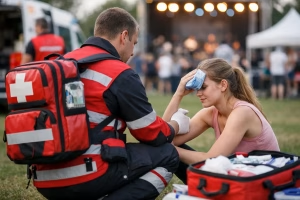
A packed village gala, a boxing show in a local hall, a school fun day on wet grass, or a charity run across mixed terrain all create very different medical demands. That is why event first aid cover should never be treated as a box-ticking exercise. The right provision depends on the crowd, the venue, the activity, and how quickly a casualty can be reached and treated.
For organisers across Scotland, the question is rarely whether first aid is needed. It is what level is proportionate, who is competent to provide it, and how it fits into the wider event plan. Getting that right protects the public, supports staff and volunteers, and gives organisers a clearer line of decision-making if something does go wrong.
Contents
- 1 What event first aid cover actually involves
- 2 Why the risk assessment matters more than headcount alone
- 3 Matching cover to the type of event
- 4 Event first aid cover and competence levels
- 5 Equipment, communications and treatment space
- 6 Working with emergency services, not instead of them
- 7 Questions organisers should ask before booking cover
- 8 The value of local knowledge in Scotland
- 9 Getting the balance right
What event first aid cover actually involves
Event first aid cover is the planned medical provision put in place for an organised activity, gathering, competition or public event. In practical terms, that can range from a single qualified first aider supporting a low-risk community event through to a team with enhanced pre-hospital capability, treatment areas, communications plans and clear escalation routes to ambulance services.
The key point is that first aid cover is not just a person with a bag. It is a service matched to foreseeable risk. That includes competent personnel, suitable equipment, reporting processes, casualty access, and a clear understanding of when a patient can be treated on site and when they need onward care.
For some events, the most common presentations are minor cuts, slips and heat exhaustion. For others, it may be trauma, intoxication, cardiac events, asthma, allergic reactions or crowd-related incidents. The provision should reflect that reality rather than rely on assumptions.
Why the risk assessment matters more than headcount alone
Organisers often begin with attendance numbers, and crowd size does matter. A larger event usually increases the chance of incidents simply because there are more people on site. But attendance is only one factor. A small event with high-risk activity can require a stronger medical presence than a much larger low-risk gathering.
A sound event risk assessment looks at the type of audience, age profile, nature of the activity, event duration, weather exposure, alcohol, remote access, trip hazards, vehicle movement, and whether the public is standing, seated or spread over a large area. It should also consider how easily emergency services can reach the location if support is required.
A family fete on a school field may present straightforward needs if vehicle access is good and the activity list is modest. A mountain bike event, equestrian competition or contact sport fixture is different. Casualties may be harder to reach, injury patterns may be more serious, and staff may need higher levels of training and more specialised equipment.
This is where organisers sometimes under-specify cover. They look at a calm start point rather than the worst credible scenario. First aid planning should be based on foreseeable incidents, not best-case conditions.
Matching cover to the type of event
There is no single model that suits every event. The right approach depends on context.
Community and school events often need visible, approachable first aid support with good access to children, older attendees and volunteers. Sporting events may need responders who are comfortable with musculoskeletal injury, head injury protocols and dynamic environments. Outdoor events need to account for terrain, weather, delayed ambulance access and communication challenges. Night-time events or those serving alcohol can see a different pattern of presentations, including assault, intoxication and falls.
The organiser should also think about pace and movement. A static indoor conference may be relatively controlled. A road race, parade or cycling event spreads risk over distance and can complicate access, handover and supervision. In those settings, the quality of planning becomes just as important as the number of personnel present.
Event first aid cover and competence levels
Not every qualified person is suited to every event. A valid certificate matters, but so does operational competence in the environment concerned.
At the lower end of risk, a trained first aider may be suitable where incidents are likely to be minor and emergency service access is straightforward. As risk increases, the organiser may need staff with broader pre-hospital care experience, stronger casualty assessment skills, or the ability to manage a patient for longer before handover.
That distinction matters. A certificated first aider working in an office environment may be entirely competent in their workplace role but not the right fit for a fast-moving sports event or a remote outdoor setting. Equally, over-providing can be inefficient for small low-risk events with limited budgets. The right answer is proportionate cover delivered by people whose training matches the expected presentations.
Equipment, communications and treatment space
Effective first aid cover depends on more than staffing numbers. Equipment should match the casualty profile and the event layout. Basic consumables may be enough for a straightforward indoor event. Higher-risk or remote settings may justify additional trauma supplies, airway adjuncts, oxygen provision where appropriate and defibrillation capability.
Communications are often overlooked until they fail. If responders cannot be contacted quickly, or if they cannot direct others to a casualty location, the practical value of having cover on site drops immediately. Large venues, outdoor spaces and moving events need a clear communications plan with tested methods and named points of contact.
Treatment space is another operational detail that matters. Some casualties can be assessed and discharged at scene, but others need privacy, shelter, monitoring or a safer area away from the public. Even a modest event benefits from identifying where first aid will be delivered and how casualties will enter and leave that area.
Working with emergency services, not instead of them
Event first aid cover supports the overall safety plan, but it does not replace NHS ambulance response or emergency department care. Good provision helps manage minor cases on site, identifies when escalation is necessary, and improves the quality of information passed on during handover.
That can reduce pressure on emergency services in some circumstances, but the real value is earlier intervention and better decision-making. A casualty with chest pain, breathing difficulty or reduced consciousness needs prompt recognition and appropriate escalation. Event staff should know the thresholds for calling 999, who makes that call, and who meets ambulance crews at the access point.
For higher-risk events, liaison with relevant agencies may form part of the planning process. That does not need to be overcomplicated, but it should be realistic and documented.
Questions organisers should ask before booking cover
The best conversations about event first aid start with the event profile, not the price. Cost matters, especially for community groups and small organisers, but the cheapest option is not always the safest or most defensible.
Ask what level of qualification the attending personnel hold and whether that is appropriate for your event type. Ask what equipment is included, whether there is incident documentation, and how staffing levels are decided. Check experience with similar events, especially if your setting involves sport, outdoor access issues, children, livestock, marine activity or large public attendance.
It is also sensible to confirm arrival times, set-up requirements, vehicle access, welfare arrangements for staff, and the process for extending hours if the event overruns. Small practical points often become the source of avoidable problems on the day.
The value of local knowledge in Scotland
Events in Scotland bring their own practical considerations. Rural access, changeable weather, seasonal daylight, ferry travel, single-track roads and patchy signal in some areas can all affect response planning. A provider that understands those realities can make better decisions about staffing, travel time, equipment and contingency planning.
That local understanding is particularly useful for agricultural shows, forestry events, water-based activities, hill races, equestrian fixtures and community events in venues where space or access is limited. Operational planning needs to reflect the actual ground conditions, not just what looks adequate on paper.
Where training and event support sit under the same roof, there is also an advantage in consistency. Providers with regulated first aid and pre-hospital training experience tend to take a clearer view of competence, equipment standards and incident management. At SPR Training, that practical approach sits behind both training delivery and event support across Scotland.
Getting the balance right
The strongest event first aid cover is not necessarily the largest team or the most expensive package. It is the provision that fits the event properly, stands up to scrutiny, and works in the real conditions of the day.
That means taking risk seriously without overstating it. It means planning for common incidents while staying ready for the less likely serious one. And it means choosing competent people who can assess, treat, record and escalate with confidence.
If you are organising an event, the most useful starting point is a realistic conversation about what could happen, how quickly help needs to reach a casualty, and what standard of care your attendees should reasonably expect. Once that is clear, the right level of cover usually becomes much easier to define.