
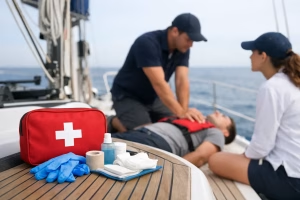
A first aid certificate for the workplace is not always enough on the water. When someone becomes unwell or injured afloat, help may be delayed, space is limited, and the conditions can make even basic treatment harder to carry out. That is exactly why the rya first aid course exists.
For anyone working, teaching or spending serious time on boats, this course is designed around real marine conditions rather than a generic classroom scenario. It focuses on the kind of incidents that can happen in marinas, on powerboats, under sail, during watersports instruction, and on inland or coastal passages where emergency services are not immediately at your side.
Contents
- 1 What is the RYA first aid course?
- 2 Who should take an rya first aid course?
- 3 What does the course actually cover?
- 4 Why marine-specific first aid matters
- 5 Is it accepted for instructor and boating requirements?
- 6 How long does the training take?
- 7 Choosing the right provider
- 8 When an RYA course may not be the right fit
- 9 What to expect from the day
What is the RYA first aid course?
The RYA first aid course is a one-day training programme developed for people who boat, instruct or work in a marine setting. It covers core first aid skills, but the context matters. Instead of treating first aid as if it happens in a warm, dry office with plenty of room and a fast ambulance response, it addresses the practical realities of delivering care on the water.
That means learners are trained to think about incidents where movement is restricted, evacuation is uncertain, and environmental factors make casualty care more complicated. Seasickness, cold exposure, drowning-related emergencies, shock, hypothermia and the effects of being afloat for extended periods all have a place in the syllabus because they are relevant to boating activity.
For some learners, the attraction is straightforward – they need the certificate to meet the requirements of an instructor or commercial endorsement pathway. For others, it is about competence. If you are responsible for crew, students, passengers or club members, you need first aid training that reflects the setting you are actually in.
Who should take an rya first aid course?
This course is a strong fit for a wide range of marine users. Dinghy instructors, sailing instructors, powerboat instructors, shorebased tutors, club safety boat crews and boating volunteers often need it for qualification or operational reasons. It is also relevant for skippers, yacht crew, paddlesport support teams and anyone regularly taking others onto the water.
Commercial and semi-commercial settings often benefit most. If you are running training sessions, safety cover, trips, hire operations or club activities, there is a clear duty of care. A marine-specific first aid certificate helps support that duty in a way a standard workplace course may not.
That said, it depends on the role. Someone who only occasionally goes afloat as a passenger may not need an RYA-specific certificate. A marina office worker with no waterside duties might be better served by an Emergency First Aid at Work course. By contrast, an instructor delivering practical sessions from a safety boat is in a very different risk category. Matching the course to the environment is the key decision.
What does the course actually cover?
The syllabus is built around immediate casualty care, but with a boating lens throughout. Learners can expect training in primary assessment, CPR, recovery position, choking, bleeding, shock and unconscious casualties. Those are the foundations and they matter in every environment.
Where the course becomes more specialised is in the marine content. It addresses cold water and hypothermia, drowning-related incidents, seasickness and dehydration, injuries commonly linked to boat handling, and the challenge of contacting and supporting rescue services when afloat. The training also looks at how to manage a casualty in a confined space and how to make practical decisions when professional help may be some time away.
This is one of the course’s main strengths. It does not pretend that a boat is simply another workplace. Casualty positioning, monitoring and onward care all become more complicated when the deck is moving, weather is changing and the nearest point of handover is not immediate.
Why marine-specific first aid matters
A first aid response that works well ashore may need adapting at sea. Even something as basic as protecting a casualty from heat loss can become more urgent on the water. A person who has fallen in, been exposed to spray for a long period, or is sitting still after an incident can deteriorate quickly if cold stress is not recognised and managed.
Communication is another factor. On land, calling 999 is usually the obvious first step. On the water, depending on location and circumstances, there may be different communication routes, location issues and delays before rescue assets arrive. First aiders need to stay useful for longer.
Then there is the simple issue of access. On a pontoon, in a cockpit, on a RIB or below deck, casualty handling is rarely tidy. You may be treating someone in awkward conditions, with limited kit, while also keeping yourself and others safe. Good marine training builds that realism into the session, so learners are not trying to translate office-based examples into boat-based emergencies.
Is it accepted for instructor and boating requirements?
In many cases, yes. The RYA first aid course is widely recognised within the boating and training sector and is commonly required for certain instructor qualifications and commercial endorsements. Exact requirements can vary depending on the qualification route, the type of boating activity, and whether additional certificates are needed alongside it.
This is where checking current awarding body or scheme guidance matters. It is never wise to assume that any first aid certificate will do. If your next step depends on holding a recognised marine first aid qualification, make sure the course you book matches that requirement.
For clubs and employers, the same principle applies. A generic certificate may be legally useful in some settings, but if your activity takes place on or around water, a boating-specific qualification is often the more defensible and operationally relevant choice.
How long does the training take?
The RYA first aid course is typically delivered over one day. That makes it accessible for busy instructors, clubs and marine businesses that need a recognised certificate without committing to a longer programme.
A one-day format is practical, but it also means the course is focused. It is not intended to turn learners into advanced medical responders. It is designed to give them the confidence to manage immediate incidents competently until help is available or handover can take place.
For some organisations, that will be enough. For others, especially those operating in more remote environments or with higher-risk participant groups, it may be sensible to build additional training around it. A broader first aid strategy can include refresher sessions, scenario practice and, where relevant, higher-level pre-hospital care skills.
Choosing the right provider
Not all first aid delivery is equal, even where the certificate title is the same. For a marine course, the provider should understand the operational reality behind the qualification. That includes the pace of watersports instruction, the constraints of small craft, and the practical expectations placed on skippers, instructors and support crews.
A good course should be clear, hands-on and compliant. It should also be delivered by trainers who can explain not just what the protocol is, but how it applies when a casualty is on a slipway, on a safety boat, or waiting for transfer ashore. That practical interpretation is what makes training stick.
For learners and organisations in Scotland, local access and flexible delivery can make a real difference. Open courses suit individuals who need a place quickly, while private delivery can work better for clubs, centres and marine teams that want the training delivered around their operations. As an RYA Recognised Training Centre, SPR Training provides marine safety training with that operational focus in mind.
When an RYA course may not be the right fit
There are cases where another first aid course is more appropriate. If your role is entirely land-based and your main requirement is workplace compliance, an Emergency First Aid at Work or First Aid at Work qualification may be the better match. If you work with children in nursery or school settings, paediatric first aid is usually the correct route. If you operate in remote outdoor settings away from boats, an outdoor first aid course may offer more relevant content.
This is not a weakness of the RYA course – it is a matter of suitability. The strongest training choice is the one that reflects your actual risk profile, your operating environment and the certification standard you need to meet.
What to expect from the day
Most learners should expect a practical classroom session with demonstration, discussion and scenario-based learning. There is usually a strong emphasis on participation, because first aid is not something you learn well by watching alone. You need to practise assessments, CPR, casualty positioning and decision-making.
For marine learners, the benefit is confidence as much as certification. If something goes wrong afloat, hesitation costs time. Training helps people recognise the problem sooner, act in the right order, and make better use of whatever equipment and support they have available.
If your boating role carries responsibility for others, the right course is not just a certificate to file away. It is part of safe operation, sound planning and professional standards. And when you are on the water, that practical difference matters more than any piece of paper.