
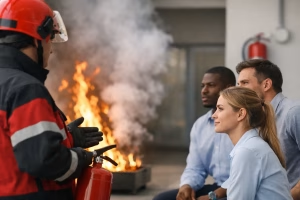
A fire door wedged open, a charger left running overnight, waste allowed to build up beside a distribution board – most workplace fires do not start with dramatic warning signs. They start with small lapses, routine shortcuts, and gaps in understanding. That is why fire safety awareness training is not a box-ticking exercise. It gives staff the judgement to spot risk early, act calmly, and support safer workplaces day to day.
For employers in Scotland, that matters on two levels. First, there is the legal and operational side. Businesses need people who understand prevention, evacuation, and basic fire response in line with workplace procedures. Second, there is the practical reality that every site is different. A nursery, a construction unit, a care setting, a workshop, and a marina may all need fire training, but the hazards, people at risk, and emergency arrangements are not the same.
Contents
- 1 What fire safety awareness training should actually cover
- 2 Awareness training is not the same as fire marshal training
- 3 Why relevance matters more than volume
- 4 Compliance matters, but competence matters more
- 5 Who needs fire safety awareness training?
- 6 Choosing the right provider for fire safety awareness training
- 7 Fire safety awareness training works best as part of a wider safety culture
What fire safety awareness training should actually cover
Good fire safety awareness training should be straightforward, relevant, and tied to the way people work. Staff do not need jargon. They need to understand how fires start, what makes them spread, and what their role is if an alarm sounds.
At a basic level, training should cover the fire triangle, common ignition sources, housekeeping, electrical safety, safe storage, and the importance of reporting hazards. It should also explain alarm systems, escape routes, assembly points, and why doors, signage, and emergency lighting matter. If staff are expected to use extinguishers, that should be made clear and taught properly. If they are not, the training should say so just as clearly.
That point is often overlooked. Many employees assume all fire training includes extinguisher use. In reality, it depends on the workplace risk assessment, the role of the individual, and the employer’s emergency plan. For some teams, awareness training is about raising the alarm, assisting evacuation, and staying safe. For designated fire marshals, the requirement is broader.
Awareness training is not the same as fire marshal training
This is where some businesses lose clarity. Fire safety awareness training is generally intended for the wider workforce. It builds general knowledge so employees can reduce fire risk and respond appropriately in an emergency. Fire marshal or fire warden training goes further. It is aimed at those with specific responsibilities such as checking evacuation routes, sweeping areas where safe to do so, managing roll calls, and supporting the employer’s fire procedures.
Neither is better in every case. It depends on the structure of the business and the level of responsibility attached to each role. An office may need all staff to complete awareness training and a smaller number to hold fire marshal certification. A compact retail unit with a small team may combine the two more closely. A higher-risk environment may require more frequent refreshers and tighter role definition.
The key is to avoid assuming one course covers every need. Training should match the findings of the fire risk assessment, the nature of the premises, and the profile of the workforce.
Why relevance matters more than volume
One of the most common weaknesses in workplace fire instruction is that it is too generic. Staff sit through content that bears little resemblance to the building, equipment, or people they work with. They may remember a few terms, but not what they would actually do if smoke was discovered in a store room or an alarm activated during a busy handover.
Relevant training is more effective because people can apply it immediately. In a workshop, that may mean focusing on hot works, fuel storage, machinery, and isolation points. In childcare, it may mean evacuation of young children, sleeping babies, and maintaining clear exits around buggies and equipment. In hospitality, it may mean kitchens, extraction systems, laundry risks, and out-of-hours procedures.
This is also where on-site delivery can make a difference. Training delivered at the client premises allows discussion around actual escape routes, known hazards, and practical responsibilities. That does not mean centre-based courses have less value. They can be the right option for mixed groups, open course availability, or individuals attending independently. The right format depends on numbers, site complexity, and the outcome required.
Compliance matters, but competence matters more
Employers often approach training because they need to meet legal duties, and that is entirely reasonable. Fire safety is a compliance issue. Staff must receive suitable instruction, and records matter. But the purpose of training is not the certificate alone. It is whether people can recognise a problem and respond properly under pressure.
That is why practical delivery matters. A short, clear session that covers real hazards, asks questions, and checks understanding is usually more useful than a longer presentation full of policy language. People need to leave knowing who calls the fire service, where they go, whether lifts can be used, how to report blocked exits, and what not to do if they discover a fire.
Refresher training matters for the same reason. Procedures fade, teams change, layouts alter, and risks shift over time. A business that has expanded into a new unit, changed its storage arrangements, or increased electrical load may need to review its training sooner than planned. There is no value in staff confidently following an old procedure that no longer fits the site.
Who needs fire safety awareness training?
In most organisations, the short answer is almost everyone. Any employee working on the premises should understand basic fire prevention and emergency arrangements. That includes office teams, warehouse staff, instructors, care staff, maintenance workers, and part-time or temporary employees.
Contractors and visiting teams also need consideration, although the level of instruction may differ. A contractor on site for one afternoon does not need the same depth of training as a permanent member of staff, but they do need to know the local emergency procedure. Likewise, volunteers, seasonal workers, and new starters should not be treated as exceptions simply because they are not permanent.
For managers, there is an added responsibility to make sure training is documented, suitable, and reflected in induction. New staff are often most vulnerable in the first weeks because they are still learning the site, the routine, and the hazards. Fire safety should not be left until the next scheduled course if someone starts tomorrow.
Choosing the right provider for fire safety awareness training
Not all training is delivered to the same standard. For employers, the right provider should be able to explain exactly what the course covers, who it is for, how long it lasts, and whether it is appropriate for the workplace. That sounds basic, but it saves time and avoids sending staff on training that does not match their duties.
Accreditation and experience matter, particularly where training sits alongside wider compliance needs such as first aid, evacuation planning, or sector-specific risk. Providers should also be able to adapt delivery where needed. A forestry team, a leisure venue, and a healthcare setting may all require the same broad subject, but the examples and discussion points should reflect the environment.
Across Scotland, many employers also need flexibility. Some want open courses for one or two delegates. Others need private group delivery on site to reduce travel and downtime. In practice, the best arrangement is often the one that staff can attend, complete properly, and use straight away. SPR Training supports both centre-based and on-site delivery across Scotland, which is often the deciding factor for businesses balancing compliance with day-to-day operations.
Fire safety awareness training works best as part of a wider safety culture
Training is only one part of effective fire safety, but it is the part that brings procedures to life. Risk assessments, alarm tests, maintenance schedules, and signage all matter. If staff do not understand them, their value drops quickly.
A workplace with strong fire awareness tends to show it in small ways. Escape routes stay clear. Faults get reported early. Staff challenge poor practice. New starters are shown what to do. That is not about creating alarm. It is about making safe behaviour normal.
For employers, that is the real value of fire safety awareness training. It reduces the chance of preventable mistakes and gives people a clearer response when something goes wrong. In a real emergency, calm action usually comes from familiar training, not guesswork – and that is worth getting right.