
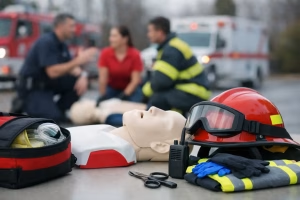
A first responder training course is not something to choose on title alone. Two courses can sound similar on paper but prepare learners for very different roles, risk levels and working environments. For employers and individuals across Scotland, the right choice comes down to what incidents you are likely to face, what level of intervention is appropriate, and whether the qualification is recognised for your sector.
Contents
- 1 What a first responder training course should cover
- 2 Who needs this level of training?
- 3 How to judge course level and suitability
- 4 First responder training course content by environment
- 5 Delivery format matters more than many employers expect
- 6 What to ask before booking
- 7 Why recognised, practical training is worth it
What a first responder training course should cover
At its core, a first responder training course sits beyond basic first aid and focuses on the first critical minutes of an emergency. That usually means a stronger emphasis on patient assessment, airway management, CPR, use of an AED, oxygen therapy, trauma management and communication during escalation to ambulance services or other clinical support.
The detail matters. A workplace first aider in a low-risk office may need confidence in primary survey, recovery position and basic life support. A responder supporting events, outdoor activities, remote work or higher-risk operations may need more. Serious bleeding, chest injuries, burns, fractures, spinal concerns and medical emergencies such as seizures or anaphylaxis require calm decision-making as well as practical skill.
Good training should not only show what to do. It should also explain what not to do, when to monitor and wait, and when immediate escalation is essential. That balance is what separates useful operational training from a course that is too broad or too basic for the role.
Who needs this level of training?
Not every setting needs the same standard. That is why employers should begin with risk, not assumption.
A first responder training course can be a strong fit for security teams, event staff, sports settings, outdoor instructors, forestry teams, remote workers, transport operations and workplaces where access to emergency services may be delayed by distance, site layout or operational hazards. It can also be relevant for healthcare support roles, community responders and organisations that want a more capable in-house response before clinical help arrives.
For some businesses, the course is part of a wider compliance picture. For others, it is about resilience. If your team works around machinery, vehicles, members of the public, lone workers or physically demanding tasks, basic first aid may not reflect the real incidents your staff could face.
There is a trade-off here. Higher-level training gives broader capability, but it also asks more of the learner. The content is more detailed, the practical assessment is more demanding, and refreshers matter if skills are to stay current. The right level is the one your team can use safely and confidently in real conditions.
How to judge course level and suitability
The quickest way to compare options is to look at four points: learning outcomes, course duration, practical content and awarding body.
Learning outcomes tell you whether the course is pitched at basic first aid level or at a more advanced first response standard. If the outcomes focus only on minor injuries and routine workplace incidents, it may not be enough for higher-risk environments. If they include structured patient assessment, trauma interventions and oxygen administration, the course is likely designed for a more operational role.
Course duration is also a clue. Short awareness sessions can be useful as introductions, but they do not replace assessed training. Where staff are expected to act in the early stages of a serious incident, hands-on contact time matters.
Practical content should be central. Learners need to handle equipment, work through scenarios and practise under instructor supervision. Emergency response is physical and time-sensitive. It cannot be learned properly from slides alone.
Accreditation is equally important. Employers should check that the qualification comes through a recognised awarding body and that the provider is approved to deliver it. That protects both quality and credibility, particularly where training records may be reviewed by clients, regulators or insurers.
First responder training course content by environment
The same qualification can land differently depending on the setting. A good provider should be able to explain how the training applies to the learner’s workplace, not just recite a syllabus.
In construction and industrial settings, responders may need a stronger grounding in crush injuries, catastrophic bleeding, falls from height, burns and scene safety around plant or live work areas. In outdoor and land-based roles, weather exposure, delayed access and casualty movement become more significant. In sports and physical activity settings, collapse, head injury and musculoskeletal trauma are more common concerns. In marine or waterside environments, rescue context and communication can shape the response even before treatment begins.
This is where sector awareness adds value. The principles of first response are consistent, but the decisions made in a warehouse, a nursery, a forest school site and a marina will not be identical. Training should reflect that reality.
Delivery format matters more than many employers expect
A course might meet the right standard on paper and still be the wrong fit operationally. Delivery format affects attendance, disruption and how well staff absorb the content.
Open courses suit individuals or smaller teams who need flexibility and a scheduled route to certification. Private group delivery works well where a business wants teams trained together, examples tailored to the site and less time lost to travel. On-site delivery can be particularly useful for practical scenarios because learners work in the environment where they may actually need to respond.
There is also the question of refreshers and CPD. Some learners need an initial qualification. Others need updates on specific skills such as airway management, haemorrhage control or oxygen therapy. Treating all staff the same can lead to wasted time for experienced responders and gaps for those who are new.
Across Scotland, travel and geography can shape the decision as well. A centrally located training centre is convenient for many learners, but for larger teams or specialist operational sites, delivery at client premises may be the better option.
What to ask before booking
The best course choice usually comes from a short, practical conversation rather than a long search through course names.
Ask what incidents the training prepares people to manage. Ask whether the certificate is accredited and by whom. Ask how much of the course is practical, what equipment is included and how learners are assessed. If you are booking for staff, ask whether the provider can adapt examples to your sector and whether training can be delivered at your premises.
It is also worth asking what previous experience is expected. Some first responder courses are suitable for beginners with the right support. Others are better for learners who already hold a first aid qualification or work in a patient-facing role. Starting at the wrong level can leave people either overwhelmed or underchallenged.
For employers, record-keeping and expiry dates should not be an afterthought. A recognised provider should make it straightforward to understand certification periods, recommended refreshers and any progression routes available if your team later needs a higher level of pre-hospital care training.
Why recognised, practical training is worth it
When an emergency happens, there is rarely time to interpret vague knowledge. Staff need a clear framework, familiarity with equipment and the confidence to act within their training. That only comes from structured teaching, realistic practice and assessment against a recognised standard.
A credible provider will also understand the difference between compliance and capability. Meeting a requirement is one thing. Making sure your people can respond effectively in the first few minutes of an incident is another. The strongest training programmes address both.
For organisations that need regulated, role-specific instruction in Scotland, that means choosing a provider with proven approval status, practical delivery options and enough sector breadth to match the course to the job. Providers such as SPR Training offer that flexibility through accredited delivery from Airdrie and on-site across Scotland, which can make a real difference for teams with mixed risks and operational demands.
The most useful first responder training course is the one that fits the incidents your people may actually face, gives them skills they can retain, and stands up to scrutiny when competence matters most.