
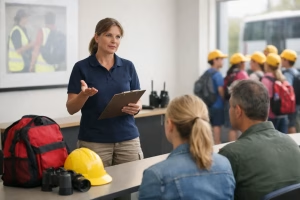
A school trip can go wrong long before the coach leaves the car park. More often than not, the weak point is not enthusiasm or planning effort – it is unclear roles, inconsistent briefing, or staff who have never been properly shown what good practice looks like. That is where a clear school trip safety training example becomes useful. It gives headteachers, educational visit co-ordinators, trip leaders and support staff a structure they can adapt to their own setting rather than relying on assumptions.
For most schools, the aim is not to turn every member of staff into a safety specialist. The aim is to make sure the adults leading pupils off site understand the foreseeable risks, know the control measures, and can respond calmly if something changes. Good training should support compliance, but it also needs to be practical enough to use on a wet Tuesday at a country park, a museum visit in Glasgow, or a multi-day residential in the Highlands.
Contents
- 1 What a school trip safety training example should cover
- 2 A practical school trip safety training example
- 3 Core content areas that matter most
- 4 How schools can deliver this training well
- 5 Where this links to accredited safety training
- 6 Common mistakes this school trip safety training example helps avoid
What a school trip safety training example should cover
A useful training example should mirror the way trips actually operate. That means it needs to move beyond a generic slide deck on risk assessment and focus on real decisions staff make before, during and after the visit.
At a minimum, training should cover legal and organisational responsibilities, supervision standards, pupil medical needs, transport arrangements, dynamic risk assessment, incident response and communication procedures. In many schools, safeguarding, behaviour expectations and medication handling also need their own section rather than being treated as minor add-ons.
There is also a difference between briefing staff and training them. A pre-trip briefing may explain timings, venue details and group allocations. Training should go further. It should test whether staff understand ratios, know what to do if a child goes missing, recognise when a plan is no longer safe, and can provide immediate first aid until further help arrives.
A practical school trip safety training example
The most effective format for many schools is a short, role-based training session delivered before trips begin for the term or school year, followed by a trip-specific briefing nearer the date. That avoids repeating basic content every time while still allowing for local risks.
Example training aim
To prepare school staff and volunteers to supervise pupils safely on off-site visits by understanding responsibilities, risk controls, emergency procedures and basic incident management.
Example audience
This training would normally suit teachers, classroom assistants, support workers, volunteers, sports staff and anyone acting as a trip leader or accompanying adult. If residentials, outdoor activity visits or water-based sessions are involved, some schools may need additional modules.
Example duration and format
A realistic format is a half-day session of around three hours. That is long enough to cover essential content without losing attention. For higher-risk visits, a full-day format may be more appropriate, especially where first aid, evacuation drills or scenario work are included.
The session could be split into four parts. First comes the school’s policy framework, including approval procedures, consent, safeguarding and lines of authority. Second is planning and risk assessment, focusing on hazards, group needs, transport, weather and venue-specific controls. Third is supervision in practice, including head counts, buddy systems, movement through public spaces and behaviour management. Fourth is emergency response, covering first aid, missing pupil procedures, escalation and communication with school leadership and parents.
Example learning outcomes
By the end of the session, participants should be able to explain their role on a trip, contribute to a suitable and sufficient risk assessment, follow agreed supervision systems, identify when conditions have changed, and respond to common incidents in line with school procedure.
That wording matters because it is measurable. If training outcomes are too vague, schools can struggle to show what staff were actually prepared to do.
Core content areas that matter most
Roles and responsibilities
Every off-site visit needs one person with overall responsibility, but safe delivery depends on the wider team understanding where their responsibilities begin and end. Staff should know who is leading, who is first aid trained, who carries medication, who manages registers, and who contacts the school in an emergency.
This is one of the most common weak spots in practice. Many incidents become harder to manage because two adults each thought the other was dealing with the issue.
Risk assessment and dynamic decision-making
Staff need to understand both planned controls and dynamic risk assessment. A written assessment completed in advance is essential, but it is not enough on its own. Weather changes, road closures happen, pupils become unwell, venues become busier than expected, and transport can be delayed.
Training should include short scenarios. For example, what happens if the coach breaks down on a dual carriageway, a pupil refuses to reboard transport, or ice makes an outdoor path unsafe? These are not unusual situations. Staff need permission to pause, reassess and escalate concerns without feeling they are overreacting.
Medical needs and first aid
Medical information should never sit in the trip file unread. Training should cover how staff access care plans, where medication is kept, who is authorised to administer it, and what to do if a pupil becomes suddenly unwell.
The level of first aid training required depends on the trip. A local museum visit presents a different risk profile from a Duke of Edinburgh expedition or a forest school session. Still, every trip team benefits from at least one appropriately trained first aider and a shared understanding of basic emergency actions. This is particularly important where asthma, severe allergies, diabetes, epilepsy or behavioural distress may affect the visit.
Supervision and group management
Ratios matter, but head counts alone do not keep children safe. Training should address transitions between locations, use of toilets in public venues, free time arrangements, remote supervision of older pupils and control of meeting points.
Age, ability and additional support needs all affect the supervision model. A secondary trip to a city-centre venue may allow some controlled independence. The same approach would be unsuitable for younger children or pupils with specific vulnerabilities. Good training makes room for that professional judgement rather than pretending one model fits every group.
Transport safety
Transport often gets treated as a simple logistical detail, when in practice it is one of the highest-risk parts of the day. Staff should know boarding procedures, seating plans where relevant, seat belt expectations, behaviour controls, roadside safety and what to do if arrival or departure is disrupted.
If minibuses are used, driver competence and organisational checks become even more significant. If public transport is used, staff need a clearer plan for split groups, platform changes and what happens if someone is separated.
Emergency procedures
Training should explain exactly what counts as an incident that can be managed on site and what requires escalation. Staff need a clear process for contacting emergency services, informing school leadership, preserving accurate records and supervising the wider group while one issue is dealt with.
A missing pupil procedure should always be practised, not just mentioned. The first ten minutes are critical, and confusion over search areas, reporting thresholds and communication can waste valuable time.
How schools can deliver this training well
The strongest training is specific to the school’s actual visit pattern. If most trips are local curriculum visits, keep the examples grounded in that reality. If the school runs adventure activities, residentials or water-based sessions, the training needs greater depth.
Short case studies usually work better than long policy readings. Staff are more likely to engage with scenarios such as a pupil suffering an allergic reaction at lunch, a coach arriving late after dark, or a parent turning up unannounced at a venue. These examples test decision-making in a way paperwork alone cannot.
Records matter as well. Schools should document attendance, learning outcomes and any competence checks used during training. That is helpful for internal assurance and can support wider compliance processes if procedures are ever questioned.
It also helps to separate induction from refresher training. New staff may need the full framework, while experienced staff benefit from updates on recurring issues, lessons from recent visits and any changes in school policy or national guidance.
Where this links to accredited safety training
Not every aspect of school trip safety sits within a formal qualification, but accredited first aid and emergency response training can strengthen the overall standard of preparedness. Where visits involve younger children, outdoor learning, sports coaching or remote settings, the right first aid provision becomes even more significant.
That is where specialist providers can add value. For example, schools and activity teams across Scotland often need paediatric first aid, outdoor first aid or emergency response training that reflects the environments they actually work in. Training is more useful when it is tied to real operational risks rather than delivered as a generic compliance exercise.
Common mistakes this school trip safety training example helps avoid
The biggest mistake is assuming experienced staff do not need training. Experience helps, but it can also lead to informal shortcuts if expectations are not regularly refreshed. Another common issue is treating volunteers as extra numbers without properly briefing them on boundaries, reporting routes and pupil management.
Some schools also put too much faith in paperwork. A completed risk assessment is necessary, but it does not prove staff can apply it under pressure. That is why discussion, rehearsal and scenario-based learning matter.
Finally, schools sometimes overcomplicate training with policy language that is technically correct but hard to use on the ground. Staff need procedures they can recall quickly when they are supervising thirty pupils in a crowded public space.
A sound school trip safety process is not about creating fear around off-site learning. It is about giving staff the competence and confidence to make sensible decisions, manage foreseeable risks and act quickly when plans change. When training is clear, relevant and grounded in real school activity, trips become easier to run well – and far safer for everyone involved.