
A casualty with chest pain at a sports ground, a diver showing signs of distress, or a first aider supporting someone with breathing difficulty after an incident – these are the moments when an oxygen administration training course moves from being a useful extra to a practical operational skill. For many workplaces and specialist settings, the question is not whether oxygen is valuable. It is whether staff are trained to use it safely, lawfully and in line with their role.
Contents
- 1 Who an oxygen administration training course is for
- 2 What the course should actually teach
- 3 Compliance, certification and why standards matter
- 4 Choosing the right format for your team
- 5 Questions employers should ask before booking
- 6 Oxygen training in specialist sectors
- 7 What good training looks like in practice
Who an oxygen administration training course is for
Oxygen is not a general first aid add-on for every workplace. Whether it is appropriate depends on your environment, your risk profile and the level of response you expect from staff. That is why course selection should start with the job role, not the equipment catalogue.
An oxygen administration training course is commonly relevant for those working in higher-risk or specialist response settings. That can include event medical teams, sports environments, diving and marine operations, security teams, outdoor instructors, first responders and organisations with remote or delayed access to ambulance support. It can also suit healthcare-adjacent roles or businesses that already maintain more advanced first aid arrangements than the legal minimum.
For lower-risk offices or small workplaces with standard first aid provision, oxygen training may not be necessary. In those settings, a well-chosen Emergency First Aid at Work or First Aid at Work course may be the more appropriate and proportionate route. The point is simple: training should match foreseeable need.
What the course should actually teach
A worthwhile course goes beyond showing someone how to turn a cylinder on and fit a mask. Oxygen is a medical gas, and poor practice can create risks rather than reduce them. Good training should therefore combine patient assessment, indications for use, equipment handling and safety controls.
Assessment before administration
Learners need to understand when oxygen may be considered and when escalation to emergency services is the priority. That means recognising signs of respiratory distress, reduced oxygenation, shock, chest pain, major trauma or other conditions where supplementary oxygen may form part of immediate care within the limits of training and local protocols.
This matters because oxygen is not a substitute for assessment. If staff cannot identify what they are seeing, they are less likely to make sound decisions under pressure.
Equipment knowledge and safe use
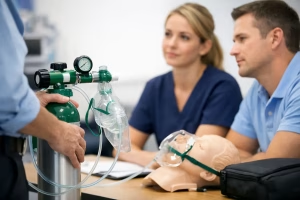
An oxygen administration training course should cover the practical differences between cylinders, regulators, tubing, masks and delivery devices. Staff should know how to check equipment, assemble it correctly, confirm flow rates and identify faults or contamination issues.
Safety is a serious part of this. Oxygen increases fire risk, storage requirements must be followed, and handling procedures need to be understood by anyone responsible for keeping equipment on site or in vehicles. In some sectors, this element is as important as casualty care.
Practical scenarios, not just theory
The best learning happens when candidates apply the skill in context. Scenario-based training helps people practise communication, positioning, monitoring and handover to ambulance crews or clinical teams. It also shows whether oxygen administration fits realistically into how that team works.
A short classroom talk may tick a box, but it will not always prepare a candidate to use the kit confidently at an incident. Hands-on assessment is where competence becomes visible.
Compliance, certification and why standards matter
Not all training carries the same weight. For employers, clubs and operational leads, the credibility of the provider matters because the course may sit within a wider duty of care, insurer expectation or internal governance process.
A recognised oxygen administration training course should clearly state who it is aimed at, what pre-requisites apply, how long it lasts and what certification is issued on successful completion. If the course is presented as accredited or aligned to a regulated standard, that should be clear from the outset.
There is also a practical reason to check this properly. Some candidates need oxygen training as part of ongoing CPD, while others need it integrated into a broader pre-hospital care pathway. A short standalone course can be suitable in one setting and inadequate in another. It depends on the role, the scope of practice and how the organisation intends to deploy the skill.
Choosing the right format for your team
The right course is not only about content. Delivery format affects attendance, consistency and how easy it is for a business to remain current.
For individual candidates or small numbers, an open course can be the most straightforward option. It offers set dates, a clear venue and a standardised learning experience. For employers with multiple staff to train, on-site delivery often makes better operational sense. It reduces travel time, allows examples to be tailored to the actual workplace and can be combined with related training where appropriate.
There is also the issue of mixed-experience groups. A complete beginner and an experienced responder may both need oxygen training, but not necessarily at the same level or in the same format. Some teams benefit from a focused update session, while others need full initial instruction with more time spent on anatomy, patient assessment and legal boundaries.
That is where a provider with a broader safety and pre-hospital training background tends to add value. They can usually advise whether oxygen administration should stand alone or sit beside basic life support, first aid, casualty care or role-specific emergency response training.
Questions employers should ask before booking
Before choosing any oxygen administration training course, it helps to ask a few direct questions. Is oxygen actually part of your emergency plan? Who is authorised to use it? Where will equipment be stored, checked and replaced? How often will trained staff realistically use the skill?
You should also look at refresher requirements. Skills fade when equipment is rarely used. If your team may only encounter a relevant incident once every year or two, periodic updates and drills are sensible. Certification alone does not guarantee current competence.
Another practical point is instructor credibility. Oxygen administration should be taught by someone with current subject knowledge and operational understanding, not simply read from a slide deck. Candidates usually recognise the difference quickly. Good instruction tends to be clearer, more realistic and easier to apply on shift.
Oxygen training in specialist sectors
In Scotland, demand for oxygen training often comes from sectors where incident patterns are less predictable and access to immediate support can vary. Outdoor settings, marine environments, sports venues and event work are obvious examples. These are places where a trained responder may need to provide immediate support while waiting for ambulance attendance or managing a casualty in a challenging location.
That does not mean every team in those sectors needs the same course. A marina, a forestry operation and a boxing club all face different risks. The equipment they hold, the distances involved and the profile of likely casualties are not the same. Training should reflect that rather than forcing everyone through a generic programme.
For some organisations, oxygen administration is best treated as part of a wider package. Combining it with first aid, CPR, AED use or trauma skills can make more sense than teaching it in isolation. It produces a more joined-up response and gives staff a clearer sequence to follow when an incident unfolds quickly.
What good training looks like in practice
A good course is usually clear, practical and realistic about limits. It should tell candidates what they can do, what they must not do and when to escalate. It should allow enough hands-on time with the equipment. It should assess understanding rather than assume it.
It should also avoid overstating what oxygen can achieve. Supplementary oxygen can support casualty care, but it is not a cure and it does not replace prompt access to emergency medical treatment. Training providers should say that plainly.
For employers, quality also shows up in administration. Clear joining instructions, transparent certification details, suitable class sizes and straightforward advice on delivery options all make a difference. If a provider cannot explain the course in practical terms before booking, that is usually a warning sign.
For organisations across Scotland looking at how this training fits their wider compliance and emergency planning, working with a provider that already delivers accredited first aid, pre-hospital and specialist sector courses can make the decision easier. SPR Training supports both individuals and employers with practical course delivery from its Airdrie base and at client premises where that suits operations better.
An oxygen administration training course is worth choosing carefully because it sits at the point where equipment, judgement and patient care meet. When the training fits the role, the setting and the level of risk, it becomes more than a certificate – it becomes a skill people can rely on when the situation is not straightforward.