
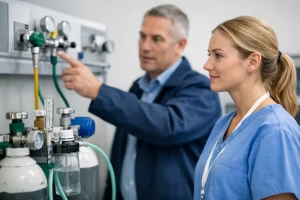
A cylinder stored badly, a regulator fitted incorrectly, or oxygen used without a clear understanding of fire risk can turn a routine task into a serious incident. That is why medical gases training matters. In any setting where oxygen or other medical gases are handled, staff need more than basic awareness. They need practical instruction that matches the risks of their role, the equipment on site, and the standard of care expected.
For some organisations, that means clinical teams using oxygen in treatment and transport. For others, it means first aiders, event medical staff, dental teams, care providers, or responders who may administer oxygen as part of an approved protocol. The training requirement is not identical in every workplace, and that is exactly the point. Good training is role-specific, compliant, and grounded in real use rather than broad theory.
Contents
What medical gases training should cover
At its core, medical gases training teaches people how to handle gases safely and use them correctly within their scope of practice. Oxygen is the gas most people think of first, but training may also touch on medical air, nitrous oxide, carbon dioxide, Entonox, or mixed gases depending on the service. The content should reflect what learners will actually encounter.
A sound course usually starts with the properties of the gases being used and the hazards they present. Oxygen, for example, is not flammable in itself, but it supports combustion. In practical terms, that changes how staff manage ignition sources, storage areas, clothing contamination, and equipment checks. If learners leave training thinking oxygen is simply another cylinder to move and attach, the course has missed the point.
Training should also cover cylinder identification, labelling, storage, transportation, and stock rotation. These are not minor admin details. Clear segregation of full and empty cylinders, protection from heat, secure storage, and correct manual handling all reduce the chance of leaks, damage, and avoidable downtime. In busy workplaces, poor storage practice tends to build up quietly until a near miss exposes it.
The next part is equipment use. Staff should understand regulators, flow meters, masks, tubing, valves, and any relevant delivery devices used by their organisation. They need to know how to assemble kit, check for faults, set prescribed flow rates where appropriate, and recognise when equipment should be taken out of use. If a team is expected to carry oxygen in vehicles or response bags, the practical side of setup and pre-use checks becomes even more important.
Medical gases training and scope of practice
This is where many employers need clarity. Medical gases training does not give every learner the same authority to administer treatment. It should sit alongside professional registration, internal policy, insurer requirements, and the level of first aid or clinical qualification already held.
A healthcare professional may require training that focuses on safe administration, monitoring, documentation, and local policy. A workplace first aider may only need awareness of storage, emergency handling, and when oxygen can be used as part of an approved workplace arrangement. A pre-hospital responder may need scenario-based practice linked to casualty assessment and escalation. The same subject area can therefore look very different depending on who is being trained.
That is also why off-the-shelf content is not always enough. A dental practice, event medical provider, and care service may all use oxygen, but their risks are not the same. One may be focused on clinical use in a controlled setting, another on transport and temporary treatment spaces, and another on storage, routine checks, and staff familiarity across shifts. Training should reflect those operational differences.
Why employers should treat it as a safety issue, not only a clinical one
Medical gases sit across several responsibilities at once. There is the patient care side, but there is also workplace safety, fire prevention, equipment management, and legal compliance. If an employer only looks at the clinical element, gaps appear quickly.
For example, a team may know when oxygen is indicated, but not how to store cylinders securely. They may be confident attaching a regulator, but less confident checking for leaks or identifying damage after transport. They may understand casualty care, but not the increased fire risk created by enriched oxygen environments. Each of those gaps carries consequences for staff, patients, premises, and insurers.
That makes refresher training worthwhile, especially where use is infrequent. Skills that are rarely used tend to fade, and medical gas equipment can vary between sites. A short update can be enough to correct poor habits, reinforce checks, and make sure procedures still match current equipment and policy.
What good practical training looks like
The strongest courses do not stop at slides and policy wording. They give learners hands-on time with the equipment they are expected to use. That includes identifying cylinders, attaching and removing regulators correctly, setting up delivery devices, carrying out checks, and responding to common faults or safety concerns.
Scenario work is useful here because it tests judgement as well as process. Can the learner recognise when a cylinder should not be used? Do they know what to do if equipment is damaged, contaminated, or empty? Can they apply safe handling principles when working in a confined room, a vehicle, or a public-facing area? Practical training exposes uncertainty before it becomes a workplace problem.
Assessment matters too. A certificate only has value if it reflects real competence. Employers should be able to see what the course covered, how learners were assessed, and whether the content aligns with their own policies and sector expectations. This is especially relevant in regulated or inspected environments where training records may be scrutinised.
Choosing medical gases training for your setting
When selecting a course, the first question is simple: what are your staff actually required to do? If the answer is limited to storage, handling, and equipment checks, a focused safety-based course may be appropriate. If staff administer oxygen or use gases during treatment, the content needs to go further and reflect that clinical responsibility.
The second question is where and how the gases are used. Permanent clinical rooms, mobile response units, event environments, and mixed-use workplaces all create different pressures. A good provider will ask about your sector, your staff group, the gases held on site, the equipment in use, and whether the need is awareness, user-level competence, or refresher training.
Accreditation and trainer credibility should also be considered carefully. In a field tied to compliance and patient safety, delivery needs to be clear, current, and supported by genuine operational knowledge. Employers are right to expect trainers who understand both the classroom standard and the real-world conditions staff work in.
For organisations across Scotland, local delivery can make a practical difference. On-site training allows learners to work with their own cylinders, storage areas, and procedures, which often produces better outcomes than generic delivery in an unfamiliar setting. Where teams are spread across multiple roles, a bespoke approach may also be more efficient than sending everyone on the same course regardless of need. That is often where a provider such as SPR Training can add value, by aligning content with the workplace rather than forcing the workplace to fit a standard package.
Common mistakes training should prevent
Most incidents do not come from one dramatic failure. They come from routine shortcuts. Cylinders are left unsecured because staff are busy. Pre-use checks are skipped because the kit was fine last week. Equipment is borrowed between departments and returned incomplete. Someone assumes another colleague has dealt with a defect. These are ordinary failings, but they create the conditions for harm.
Training should challenge those assumptions. It should make clear who is responsible for checks, how faults are reported, when equipment must be removed from use, and what storage standard applies on site. It should also address the false confidence that can build up around familiar equipment. People often become casual with the things they handle regularly.
That is why the best training is specific, practical, and repeated at sensible intervals. Not because staff are careless, but because safe handling depends on clear systems and refreshed competence.
If your organisation stores or uses oxygen or other medical gases, training is not an optional extra to deal with later. It is part of running a safe service. The right course gives staff confidence, helps employers meet their obligations, and reduces the risk of preventable incidents before they happen.