
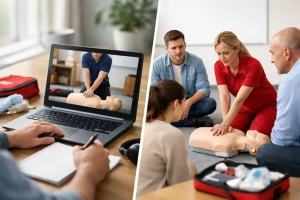
When a business books first aid training, the real question is not simply which course to choose. It is whether blended learning vs classroom first aid is the better fit for the people attending, the risks they face at work, and the standard of competence the employer needs to see on the day.
That decision matters more than many buyers expect. A course can be fully compliant on paper yet still be the wrong format for a nursery team, a forestry contractor, a gym instructor or an office-based workplace first aider. Delivery method affects attendance, confidence, practical performance and, in some cases, how well learners retain key actions under pressure.
Contents
- 1 Blended learning vs classroom first aid – what is the difference?
- 2 Why delivery format matters in first aid
- 3 Where blended learning works well
- 4 Where classroom first aid is often the stronger choice
- 5 Compliance is only part of the decision
- 6 Blended learning vs classroom first aid for different sectors
- 7 Questions employers should ask before booking
- 8 Choosing the right provider matters as much as the format
- 9 So which should you choose?
Blended learning vs classroom first aid – what is the difference?
In straightforward terms, classroom first aid is delivered face to face, with all teaching and practical assessment taking place in person. Learners attend for the full course duration and work through the theory, demonstrations, scenarios and assessments with an instructor in the room.
Blended learning splits the course into two parts. The theory element is completed online first, usually through guided e-learning, and the practical section is then delivered in person. This reduces classroom time while keeping the hands-on training and assessment that first aid qualifications require.
For many employers, the appeal of blended learning is obvious. Staff spend less time away from normal duties, training dates can be easier to schedule, and learners can work through background knowledge at their own pace. For others, especially where confidence is low or practical decision-making is critical, the classroom remains the stronger option.
Why delivery format matters in first aid
First aid is not just knowledge recall. It is recognition, judgement, communication and practical action. A learner must identify what is wrong, prioritise what to do next, and carry out treatment safely. That is why format should never be chosen on convenience alone.
A confident learner with solid digital skills may complete the online theory element very effectively before arriving for practical training. Another learner may technically finish the e-learning but retain very little, simply because they learn better by asking questions in real time and hearing the subject explained by an instructor.
This is where employers sometimes make the wrong call. They assume that if blended learning is available, it is automatically the better option because it saves time. It can save time, but the better option is the one that produces competent first aiders for your environment.
Where blended learning works well
Blended learning tends to suit organised teams who are comfortable using online systems and can set aside uninterrupted time to complete the theory element properly. It also works well where employers need to reduce time off the job without removing the practical standard required for certification.
Office settings are often a good example. Learners can complete the theory in advance, then attend a shorter practical session focused on CPR, use of an AED, recovery position, choking, bleeding control and incident response. For low to moderate risk environments, that can be an efficient and entirely sensible route.
It can also suit experienced staff who are renewing rather than starting from scratch. Someone who already understands the structure of first aid training may find online theory straightforward, leaving the classroom time to refresh physical skills and scenario-based thinking.
The same can apply to dispersed teams across Scotland. If staff are travelling from different sites, reducing classroom attendance from several days to a shorter practical block may make training more manageable.
Where classroom first aid is often the stronger choice
Classroom delivery remains the better fit where the learner group needs more support, where practical discussion is central, or where the workplace risk profile is higher.
For new first aiders, face-to-face teaching often builds confidence more quickly. They can ask questions as they arise, watch repeated demonstrations, and learn from the experiences of others in the room. That matters if the person may one day be first on scene at a serious workplace incident.
It is also a strong choice for sectors where context matters. Childcare teams, outdoor instructors, construction workers, equestrian settings and some healthcare environments do not just need generic first aid knowledge. They need the training brought to life through realistic examples, employer-specific discussion and practical coaching.
In these settings, classroom time often delivers more than the syllabus alone. Learners talk through likely incidents, equipment locations, reporting lines and site constraints. An instructor can correct technique immediately, challenge assumptions and adapt scenarios to match the role.
For some groups, that interaction is the difference between a certificate and real readiness.
Compliance is only part of the decision
A common mistake is to treat first aid training as a purchasing exercise based only on duration and cost. Compliance matters, of course. Employers need recognised, appropriate training that meets workplace requirements. But compliant delivery still needs to be suitable for the learners and the working environment.
If a course is technically acceptable yet learners arrive underprepared for the practical session, struggle to engage with the online element, or leave without confidence in their own ability, the training has not done its job properly.
This is especially relevant for employers carrying out a first aid needs assessment. The assessment should not just identify how many first aiders are needed. It should also consider the level of risk, likely injuries, workforce patterns, lone working, travel, remote sites and how staff learn best.
That usually brings the answer into clearer focus. A low-risk office with experienced staff may do very well with blended delivery. A mixed-ability workforce in a more hands-on setting may benefit far more from full classroom teaching.
Blended learning vs classroom first aid for different sectors
There is no single right answer across all industries. The better route depends on what happens in your workplace and who is attending.
For offices, retail teams and some hospitality settings, blended learning can be a practical option where learners are comfortable completing theory independently. For nurseries, schools and paediatric settings, classroom delivery is often preferred because discussion, confidence and scenario work play such a large part in the learning experience.
For construction, manufacturing, forestry and outdoor work, the balance usually shifts even further towards classroom-based training. These environments carry greater risk, and learners often benefit from more direct instructor input around trauma response, casualty management and incident priorities.
For sports coaches, personal trainers and community groups, it depends on the level of prior experience. Some learners value the flexibility of blended learning. Others gain much more from face-to-face delivery where practical technique can be refined in the room.
Questions employers should ask before booking
Before choosing a format, ask a few practical questions. Will staff genuinely complete the online element properly and on time? Are they comfortable learning independently? Is the workplace relatively low risk, or are injuries likely to be more serious or more complex? Are learners new to first aid, or are they refreshing existing knowledge?
Also consider logistics honestly. If taking staff out of operations for full classroom days is difficult, blended learning may solve a real problem. But if the result is rushed completion of online theory late at night or during breaks, the time saving may be false economy.
Training should fit operations, but it should also be protected time. First aid is too important to treat as a box-ticking exercise.
Choosing the right provider matters as much as the format
The quality of delivery matters whichever route you choose. In blended courses, the online learning needs to be clear, structured and relevant, and the face-to-face session needs to focus on practical competence rather than simply racing through assessments. In classroom courses, the teaching needs to stay grounded in real workplace application rather than generic slides and repetition.
For organisations across Scotland, it often helps to work with a provider that understands sector-specific risk and can advise on which format is genuinely suitable, rather than pushing one model for every client. That is especially useful where businesses need on-site delivery, mixed course requirements or more than one type of safety training. Providers such as SPR Training are often chosen for exactly that reason – accredited delivery, flexible arrangements and training that reflects the setting learners actually work in.
So which should you choose?
If your priority is flexibility, reduced classroom time and easier scheduling for capable, self-directed learners, blended learning may be the right fit. If your priority is confidence-building, stronger instructor support and a more guided learning experience, classroom first aid is often the better choice.
Most importantly, do not choose the format first and then force the learners to fit it. Start with the workplace, the risk level and the people being trained. The right decision is the one that produces first aiders who can act quickly, calmly and correctly when somebody needs help.
A good first aid course should leave people not only certified, but ready to step forward when it counts.