
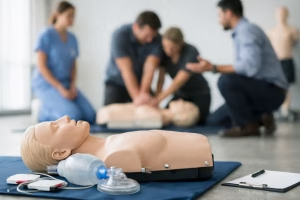
When someone asks, what is annual BLS update, they are usually trying to work out whether they need a full requalification or a shorter refresher to keep their basic life support skills current. That matters, because BLS is not a theory-only subject. It relies on recall under pressure, correct practical technique, and confidence in the first few minutes of an emergency.
In most settings, an annual BLS update is a refresher session completed every year to revisit the core skills of basic life support. It is designed to help staff maintain competence between formal qualifications, especially in roles where responding to collapse, cardiac arrest, choking or an unresponsive casualty is part of workplace expectation or professional practice.
Contents
- 1 What is annual BLS update training?
- 2 Why annual BLS updates matter
- 3 Who usually needs an annual BLS update?
- 4 What an annual BLS update usually covers
- 5 Annual BLS update vs full BLS course
- 6 Is an annual BLS update a legal requirement?
- 7 How long does an annual BLS update take?
- 8 What to look for in a BLS update provider
- 9 When an annual update may not be enough
What is annual BLS update training?
Basic life support training covers the immediate actions taken to preserve life before advanced help arrives. An annual update revisits those actions so that staff do not rely on training completed years ago and rarely practised since.
The content often includes scene safety, checking for a response, opening the airway, assessing breathing, contacting emergency services, performing CPR and using an AED where appropriate. Depending on the workplace or learner group, it may also include choking management, recovery position and recording or reporting after an incident.
The key point is that an annual BLS update is not always the same as a full initial course. It is usually shorter and assumes the learner has already completed recognised training before. The update focuses on retaining competence, correcting drift in technique and reflecting any changes in accepted guidance or local procedures.
Why annual BLS updates matter
Skills fade faster than most people expect. Even staff who passed a course confidently can lose pace, accuracy and confidence if they do not rehearse the practical steps. In a real emergency, hesitation costs time.
That is why annual updates are widely used across healthcare, care services, education, fitness, community settings and higher-risk workplaces. They help organisations show that first response skills are being maintained, not simply filed away as a past certificate.
There is also a compliance and governance angle. Some employers, regulators and insurers expect regular updates as part of a wider training matrix. In healthcare and clinical environments, annual BLS refreshers are often built into mandatory training because resuscitation skills must be current, not merely previously achieved.
For non-clinical workplaces, the position can vary. A business may not always be under a specific legal duty to arrange a yearly BLS refresher for every employee, but it may still be the sensible standard if staff are designated first aiders, work with vulnerable groups, supervise sport, or operate in remote or higher-risk environments.
Who usually needs an annual BLS update?
It depends on the role, the setting and the awarding body requirements. Healthcare professionals commonly complete annual updates because their employer or professional framework expects it. Care staff, dental teams, nursery workers, coaches, personal trainers and responders in leisure or public-facing environments may also be asked to refresh BLS regularly.
Some people attend because a regulator requires evidence of ongoing competence. Others do so because their employer wants a practical refresher between longer first aid qualifications. That is particularly common where staff may be first on scene before ambulance crews arrive.
For example, a gym instructor may need current CPR and AED confidence because collapses can happen without warning. A childcare setting may want staff to revisit resuscitation skills each year even where a broader paediatric first aid certificate runs for longer. A forestry or outdoor team may choose annual updates because distance from immediate medical support changes the risk picture.
What an annual BLS update usually covers
A good update session should be practical, current and relevant to the learner’s environment. It is not there to pad out time. It should put hands back on the manikin, revisit emergency sequencing and allow instructors to correct technique.
Most annual BLS updates include the primary survey, recognition of cardiac arrest, adult CPR and AED use. If the audience requires it, infant and child basic life support may also be included. Choking management is often revisited because it is a common workplace concern and a skill people can forget if they have not used it in practice.
In some sectors, the update may also cover infection prevention measures, teamwork during resuscitation, local escalation procedures and documentation. Clinical staff may need content aligned to their workplace policy. Non-clinical teams may need a simpler workplace-first-response focus.
That is why course selection matters. One BLS update is not automatically suitable for every organisation. A nursery, a care home, a construction firm and a marine training environment do not all need the same examples or emphasis.
Annual BLS update vs full BLS course
This is where confusion often starts. People hear “update” and assume it renews everything in the same way as a complete qualification. Sometimes it does what they need. Sometimes it does not.
A full BLS course is normally for first-time learners or those whose previous training has lapsed beyond an acceptable point. It provides complete instruction from the ground up, more time for assessment and a fuller introduction to the underpinning principles.
An annual update, by contrast, is a refresher. It is best suited to people who already hold relevant training and need to maintain practical competence. The session may be shorter because the learner is not starting from zero.
Before booking, it is worth checking three things: whether your employer accepts an update in place of a full renewal, whether your awarding body or regulator sets a minimum standard, and whether your previous certificate is still valid. If any of those points are unclear, ask before training rather than afterwards.
Is an annual BLS update a legal requirement?
There is no single answer that covers every sector in Scotland or the wider UK. The legal and regulatory position depends on the workplace and the role.
For some healthcare and care roles, annual BLS updates form part of mandatory training frameworks or employer policy. In those cases, the requirement is straightforward. For other sectors, the law may require adequate first aid provision without stating that every employee must complete yearly BLS refreshers. The employer then has to assess risk, staffing, public contact, casualty profile and likely response times.
That means annual updates are often a best-practice decision rather than a blanket legal rule. If your team works with children, vulnerable adults, members of the public, remote sites or physically demanding activities, annual refreshers can be a sensible control measure even where legislation is less prescriptive.
How long does an annual BLS update take?
Many update sessions are delivered in a few hours rather than over a full day, but duration varies with the learner group and the content required. A straightforward workplace BLS refresher may be relatively short. A session that includes paediatric elements, choking, AED use and practical assessment may take longer.
Shorter is not always better. If the session is too compressed, learners may not get enough hands-on practice. For BLS, practical repetition matters. People need time to rehearse compressions, ventilation technique where taught, and decision-making around calling for help and using an AED.
For employers arranging training across a team, delivery can also be tailored. On-site updates often make sense where several staff need training and the scenarios can be matched to the actual workplace.
What to look for in a BLS update provider
The provider should be clear about who the training is for, what standard it meets and whether it is an update or a full course. That sounds obvious, but vague course titles cause problems.
You should also expect qualified instructors, suitable manikins and AED training equipment, and a practical teaching approach rather than a slide-heavy session. If your staff need training for a regulated environment, accreditation and course suitability should be confirmed in advance.
For employers, flexibility matters too. A provider who can deliver at your premises across Scotland, adapt examples to your sector and align training with staff roles is usually more useful than a generic one-size-fits-all session. SPR Training, for example, works with a wide mix of sectors, which matters when course content needs to match real operational risk rather than a generic classroom scenario.
When an annual update may not be enough
There are times when a simple refresher is the wrong option. If staff have not trained for several years, have little confidence, or cannot demonstrate core practical skills, a fuller course may be the safer choice. The same applies where role requirements have changed or where previous training did not include the level of content now needed.
An update is also less suitable for complete beginners. Refresher training works because it builds on existing knowledge. Without that base, learners may leave with gaps in understanding even if they have attended in good faith.
That is why training decisions should be made on evidence, not assumption. Look at role requirements, expiry dates, previous certification and actual confidence levels in the team.
If you are weighing up what is annual BLS update training and whether it is right for your staff, the simplest test is this: does your team need a practical skills refresh to stay current, or do they need full teaching and reassessment from the start? Getting that distinction right helps protect both compliance and real-world response when it matters most.