
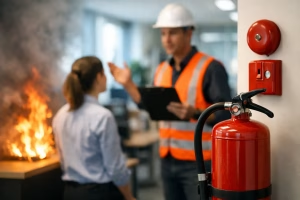
A fire alarm at 10.15 on a wet Tuesday morning tends to expose the truth about a workplace very quickly. People either know where to go, who is checking the toilets, how visitors are accounted for, and what happens next – or they do not. That is why a clear guide to workplace fire safety duties matters. It is not just about meeting legal expectations. It is about making sure people can act properly under pressure, in the actual building, with the actual risks they face.
Across Scotland, fire safety duties vary slightly in how they play out from one setting to another. A small office, a nursery, a workshop, a care environment and a marine training premises will not all manage fire safety in the same way. The legal principles are consistent, but the controls, training needs and evacuation arrangements depend on occupancy, layout, equipment, and the people using the site.
Contents
- 1 What workplace fire safety duties actually cover
- 2 The employer’s core responsibilities
- 3 Fire risk assessment is not just paperwork
- 4 The role of managers, supervisors and nominated staff
- 5 Staff duties matter as well
- 6 Training and drills in a workplace setting
- 7 Different workplaces, different fire safety pressures
- 8 Common gaps that create avoidable risk
- 9 Building a stronger culture around fire safety duties
What workplace fire safety duties actually cover
When employers look for a guide to workplace fire safety duties, they are usually trying to answer two questions. First, what does the law expect us to do? Second, what does that mean in day-to-day practice for managers, supervisors and staff?
In practical terms, workplace fire safety duties cover prevention, protection and response. Prevention means reducing the chance of fire starting. Protection means having the right measures in place to limit harm if one does start. Response means ensuring people know what to do, who takes charge, and how evacuation or other emergency arrangements will work.
That includes routine areas such as housekeeping, electrical safety, storage of combustibles, escape routes, alarm systems, emergency lighting, fire doors, extinguisher provision, evacuation procedures, and staff instruction. It also includes less obvious issues such as lone working, contractor control, personal emergency evacuation plans, and how temporary changes to the premises affect fire safety.
The employer’s core responsibilities
The main duty sits with the employer or the person in control of the premises. That responsibility cannot be handed off simply by nominating a fire marshal or booking a training course. Support can be delegated, but accountability remains with those managing the workplace.
A suitable fire risk assessment is central to that duty. This should identify fire hazards, the people at risk, the adequacy of existing controls, and any further action needed. In lower-risk settings, the assessment may be relatively straightforward. In more complex workplaces, especially where sleeping risk, vulnerable occupants, hot works, flammable substances or complicated layouts are involved, it needs much more detail and regular review.
Employers must also put in place appropriate fire precautions. That means the physical and procedural measures needed to keep people safe. There is no value in having an alarm system if staff do not recognise different alarm points, or in marking escape routes if they are routinely blocked by stock, buggies, bins or equipment.
Information and instruction are equally important. Staff need to understand the fire risks in their own work area, how to raise the alarm, where to evacuate, who assists with checks, and what not to do. In many workplaces, that should be reinforced through induction, refresher training, drills and supervision rather than treated as a one-off exercise.
Fire risk assessment is not just paperwork
One of the most common problems in fire safety management is treating the assessment as a folder on a shelf. A fire risk assessment only helps if it reflects the live reality of the premises.
If you have altered room use, increased storage, introduced battery charging areas, taken on new staff, changed shift patterns or started using contractors more regularly, the original assessment may no longer be enough. The same applies if your workforce includes people who would need assistance to evacuate, or if a business has expanded from a simple office into mixed-use operational space.
A sound assessment should answer practical questions. Where could a fire start? How quickly could it spread? Who might not hear the alarm, understand the warning, or get out without help? Are escape routes obvious and available? Are staff expected to tackle incipient fires, and if so, have they been trained properly? Those questions shape the controls that follow.
The role of managers, supervisors and nominated staff
Day-to-day compliance usually depends on line management. Senior leaders may approve policy and budgets, but supervisors often spot the blocked exit, the wedged fire door or the overloaded extension lead. That is why fire safety duties need clear ownership at more than one level.
Managers should know what checks are required in their area, how defects are reported, and what action they are authorised to take. Nominated fire marshals or wardens can support evacuation, sweep procedures and local awareness, but they need a role description that matches the site. A fire marshal in a two-room office has different practical duties from one in a warehouse, school or leisure facility.
There is also a balance to strike. Some employers appoint several marshals and assume the issue is covered. Others rely too heavily on one trained individual who is absent half the week. Fire safety arrangements need enough resilience to work during holidays, sickness, shift changes and peak occupancy.
Staff duties matter as well
Employees are not passive in this process. They have a duty to take reasonable care, follow fire safety procedures, attend training, report hazards and use equipment properly. In practice, this means not storing materials in escape routes, not tampering with detectors, not wedging fire doors open, and not ignoring repeated near misses such as overheating kit or poor charging practices.
Staff should also know the limits of their role. In many workplaces, evacuation is the priority and firefighting is only for very small, early-stage incidents where the person has been trained and has a clear exit behind them. That depends on the setting. A kitchen, workshop or plant area may justify more specific extinguisher awareness than a low-risk administrative office.
Training and drills in a workplace setting
Training should be proportionate to risk, but it should always be practical. Generic briefing slides rarely change behaviour on their own. People need to understand the actual layout of their building, the alarm arrangements, assembly points, escape route options and any responsibilities they hold during an evacuation.
For many organisations, a basic level of fire safety awareness should form part of induction and regular refresher training. Where staff are expected to act as fire marshals, manage visitors, support vulnerable occupants or work in higher-risk conditions, more specific instruction is needed. That is where accredited, workplace-relevant training adds value because it links legal duties with realistic emergency action.
Drills are often the moment when weak points become obvious. Perhaps an assembly point is too close to the building, perhaps a side exit is not opening cleanly, or perhaps contractors have not been briefed at all. A drill should not be treated as a nuisance. It is one of the few controlled chances to test whether procedures make sense under time pressure.
Different workplaces, different fire safety pressures
A standard office may focus on electrical equipment, housekeeping and evacuation management for visitors or hybrid staff. A construction site may need tighter controls around temporary electrics, hot works, changing layouts and welfare units. A nursery or childcare setting has obvious issues around assisted evacuation and maintaining calm while moving children safely.
Industrial and workshop environments often involve higher fuel loads, machinery, isolation procedures and more demanding maintenance controls. In care, hospitality or accommodation settings, occupants may be asleep, unfamiliar with the premises or unable to self-evacuate. The point is not to make fire safety complicated for its own sake. It is to recognise that a generic system can leave gaps when the environment is more complex than it first appears.
Common gaps that create avoidable risk
The same failings appear repeatedly across many workplaces. Escape routes become storage space. Fire doors are held open for convenience. New starters receive a quick verbal briefing but no real induction. Extinguishers are present, but nobody is confident about when to use them. Risk assessments are copied from older versions and never revised.
Another common issue is assuming maintenance contractors are solely responsible for compliance. Servicing alarms, extinguishers or emergency lighting is essential, but it does not replace local management. Someone on site still needs to notice faults, follow up actions and make sure staff know what the equipment is for.
Building a stronger culture around fire safety duties
The most reliable workplaces do not treat fire safety as a once-a-year exercise. They build it into routine management. Checks are completed because they are operationally necessary, not because an audit might happen. Staff report hazards because they know something will be done. Training is refreshed before knowledge fades, not after a problem.
That culture usually starts with clarity. People need to know what is expected of them, what good practice looks like, and who to speak to when controls are slipping. For employers across Scotland, that often means combining a current fire risk assessment, competent local oversight and training that reflects the site rather than a generic script.
Where teams need formal fire marshal or fire safety instruction, practical delivery makes a difference. Providers such as SPR Training support employers with recognised, workplace-focused training that helps turn compliance requirements into usable skills.
If your fire safety arrangements only look convincing on paper, they are unlikely to hold up when the alarm sounds. The useful test is simple: could every person in the building get out safely, and does everyone know their part in making that happen?