
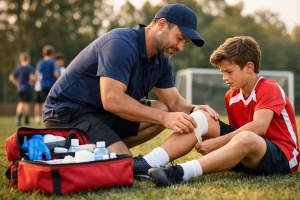
A player goes down, the session stops, and every eye turns to the coach. That is the moment behind the question what first aid does a sports coach need. For most coaches, the answer is not simply “a first aid course”. It depends on who you coach, where you coach, the level of contact in the sport, and whether your organisation or governing body sets a specific standard.
A sports coach is often the first person on scene when an injury happens. That does not mean acting as a clinician, but it does mean recognising a problem quickly, giving safe immediate care, and knowing when to escalate to emergency services, parents, venue staff, or event medical cover. Good training supports safeguarding, risk management and duty of care as much as it supports casualty care.
Contents
- 1 What first aid does a sports coach need in practice?
- 2 The baseline knowledge most coaches should have
- 3 Which first aid course is right for different coaching settings?
- 4 Governing body rules and venue requirements matter
- 5 What should a sports coach be ready to deal with?
- 6 Training is only part of the answer
- 7 Choosing a course without overtraining or undertraining
What first aid does a sports coach need in practice?
In practice, most sports coaches need first aid training that matches the environment they work in rather than a generic one-size-fits-all certificate. A coach delivering fitness classes to adults in an indoor venue may need a standard emergency first aid qualification. A football coach working with children will usually need paediatric considerations as well. A mountain bike, paddlesport or forest-based coach may need outdoor first aid because help could be delayed and environmental factors matter.
The key point is that coaching risk is dynamic. A low-contact session in a sports hall is different from a full-contact match, and both are different again from remote training, equestrian work or water-based activity. The right course is the one that reflects the realistic incidents you may face and the time it could take for further help to arrive.
The baseline knowledge most coaches should have
Whatever the sport, there is a core first aid skill set that is relevant across coaching roles. Coaches should be able to assess a scene, manage a casualty safely, and call for help clearly. They should understand CPR, use of an AED, choking, severe bleeding, shock, seizures, asthma, minor head injuries, sprains, fractures and suspected spinal injury precautions.
For sport, some topics carry extra importance. Head injury recognition matters because concussion can be missed or minimised in competitive environments. Soft tissue injury management matters because strains, sprains and impact injuries are common. So does dealing with collapses linked to cardiac events, asthma attacks, heat exhaustion, hypothermia and diabetic emergencies.
This does not mean every coach needs advanced pre-hospital care. It means the training should prepare them to manage the first few critical minutes competently and within their role.
Which first aid course is right for different coaching settings?
Adult sport in a normal venue
If you coach adults in a gym, studio, sports hall or club setting with prompt access to emergency services, an Emergency First Aid at Work course is often a sensible starting point. It covers immediate life-threatening situations and common injuries in a structured, recognised format. For many clubs and employers, this gives a clear baseline of competence.
That said, some venues or organisations may expect a fuller First Aid at Work qualification, particularly if the coach is also part of the wider staff first aid provision. This is less about the title “coach” and more about the employer’s risk assessment.
Coaching children and young people
If you work with under-18s, paediatric first aid can become highly relevant. Children are not simply smaller adults. Assessment, communication and some treatment priorities differ, especially with younger age groups. A children’s football coach, gymnastics instructor or holiday club leader may need training that covers infant and child casualties as well as safeguarding-linked response.
In mixed roles, it may be appropriate to hold both workplace-style first aid and paediatric content, or to complete a course designed around the age group you actually supervise.
Outdoor and remote coaching
Outdoor coaching changes the picture. If you lead sessions in parks, hills, woodland, on trails or in other locations where ambulance access could be delayed, outdoor first aid is often the better fit. These courses usually place more emphasis on extended casualty care, environmental exposure, incident management and decision-making when immediate evacuation is not straightforward.
This matters for running coaches, forest school leaders, Duke of Edinburgh staff, equestrian professionals and adventure instructors. A minor injury in town can become a more serious situation when the casualty is cold, wet, far from vehicle access or difficult to move.
Higher-risk and contact sport environments
Boxing, rugby, martial arts and similar disciplines bring a different risk profile. Here, management of bleeding, head injury awareness, fracture precautions and referral decisions carry more weight. Some governing bodies specify exactly what level of training coaches must hold, and event organisers may impose additional medical requirements.
For these environments, basic first aid may still be the minimum, but scenario-specific CPD can be just as important. A coach should be trained for the incidents that are most likely in their sport, not just the incidents covered in a generic classroom example.
Governing body rules and venue requirements matter
A common mistake is assuming one certificate covers every coaching role. In reality, governing bodies, local authorities, schools, leisure trusts and insurers may all have a say. Some sports require a named first aid qualification for coaching licences. Others leave it to the club’s risk assessment. Schools and community lets may require evidence of current first aid training before access is granted.
This is why the question what first aid does a sports coach need should always be followed by another question – who sets the standard in this setting? The answer could come from an employer, a sports governing body, a facility operator, or the overall event plan.
If you coach across more than one environment, the highest-risk role should usually guide your training choice. It is better to train to the reality of the work than to rely on the minimum for the easiest part of it.
What should a sports coach be ready to deal with?
Sports first aid is not only about dramatic injuries. Coaches are more likely to encounter a mix of common issues and occasional serious incidents. In routine sessions, that may mean cuts, nosebleeds, sprains, strains, dislocations, blisters, asthma symptoms or fainting. During matches or harder training blocks, the risks can include concussion, fractures, dental injury, severe bleeding or collapse.
Heat and cold also matter in Scotland. Summer sessions can bring dehydration and heat illness. Winter sessions can involve cold stress, slips, and delayed response times in poor weather. For outdoor and water-based coaching, exposure and evacuation planning become part of first aid decision-making.
A useful course should cover the clinical basics, but it should also teach practical judgement. When is a player fit to leave with a parent? When do you stop the session? When should you call 999? When should a casualty not be moved? Those decisions are what coaches actually face.
Training is only part of the answer
Even the right certificate is not enough on its own. Coaches also need suitable first aid equipment, a clear incident reporting process, access to emergency contact details, and a plan for summoning help. If you coach children, consent and parent communication arrangements should be sorted before an incident happens. If you coach outdoors, location information and access points should be known in advance.
AED access is another practical issue. If your venue has one, coaches should know where it is, how to get it quickly, and who calls emergency services while care begins. If there is no AED on site, that should be understood as part of the venue risk picture.
Refresher training matters as well. First aid is perishable. Coaches who only revisit it when a certificate expires often find that confidence drops long before then. Short updates and sport-specific CPD can keep knowledge current and improve response under pressure.
Choosing a course without overtraining or undertraining
There is a balance to strike. Some coaches sign up for the shortest available option because they want a certificate for compliance. Others assume they need the most advanced course available. Neither approach is always right.
A yoga instructor in a managed indoor venue may not need the same training as a rugby coach covering away fixtures. A personal trainer who works one-to-one with adults has different needs from a school PE coach supervising mixed-age groups. Cost, course length and operational relevance all matter, but relevance should come first.
For many organisations, the best route is a risk-based decision supported by accredited training. That means looking at participant age, injury patterns, venue type, remoteness, staffing levels, emergency response time and any governing body rules before booking a course. Providers such as SPR Training can tailor delivery around those factors, which is often more useful than sending staff on a generic programme that only partly matches the role.
A coach does not need to be a paramedic. They do need to be prepared, current and competent within the demands of their setting. If your first aid training reflects the sport, the participants and the environment, you are far more likely to make calm, safe decisions when it counts.