
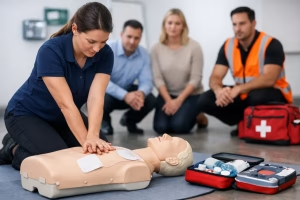
When a workplace incident happens, the first few minutes are rarely tidy or convenient. They happen on factory floors, in school halls, on building sites, in yards, on boats, and in offices where people assume serious emergencies are unlikely. That is where onsite first aid training benefits become clear. Training delivered at your own premises gives staff relevant, practical instruction in the environment where they may actually need to respond.
For many employers, the question is not whether staff need first aid training, but how to deliver it in a way that is compliant, efficient and genuinely useful. Offsite courses still have a place, particularly for individuals joining open programmes, but onsite delivery often makes better operational sense for teams. It reduces disruption, allows training to reflect real workplace risks, and helps turn a certificate into something staff can apply with confidence.
Contents
- 1 Why onsite first aid training benefits employers
- 2 Training that reflects the real risks on site
- 3 Better engagement from staff
- 4 Onsite first aid training benefits compliance and record keeping
- 5 Less downtime, more practical value
- 6 Stronger confidence in a real incident
- 7 A better fit for specialist sectors
- 8 When onsite training is the right choice
Why onsite first aid training benefits employers
The most obvious advantage is convenience, but that undersells it. When training is delivered onsite, employers can organise learning around shift patterns, staffing levels and operational demands. That matters in sectors where taking several people off the rota for a full day or more can create pressure elsewhere.
For a nursery, that may mean maintaining ratios. For a construction firm, it may mean avoiding delays to planned work. For a warehouse, it may mean arranging training around peak dispatch periods. Onsite delivery gives more control over the logistics, which usually means training is more likely to happen on time and be renewed properly rather than pushed back.
There is also a financial benefit that goes beyond course fees. Travel costs, accommodation where relevant, mileage claims, and lost time between venues all add up. If a group can be trained together at one location, the overall cost per person is often more efficient. That does depend on numbers, of course. For one or two learners, an open course may still be the more sensible option. For teams, onsite training is often the practical choice.
Training that reflects the real risks on site
A standard syllabus is essential for accredited first aid courses, but good delivery always connects that syllabus to the workplace itself. This is one of the strongest onsite first aid training benefits. Learners are not trying to imagine where an incident might happen or what equipment is available. They can think in practical terms about actual access routes, first aid kit locations, welfare areas, evacuation points and likely hazards.
That matters because risk is not the same in every setting. An office may need confidence in dealing with sudden illness, cardiac events, slips and trips. A forestry team may need to think more seriously about catastrophic bleeding, delayed ambulance access and remote working. A sports setting may focus on fractures, head injuries and managing incidents until further help arrives. In childcare, the priorities and safeguarding context are different again.
When training is delivered at the workplace, examples can be tailored properly. Discussions become more specific. Scenario work becomes more credible. Staff are more likely to ask useful questions because they can relate the content directly to their role.
Better engagement from staff
People learn first aid best when it feels relevant. If staff spend the day in an unfamiliar venue working through generic examples, some will still engage well, but others will treat it as a compliance exercise. Onsite delivery usually improves attention because the training feels closer to the realities of their working day.
That is particularly useful in mixed teams where previous experience varies. Some learners may be complete beginners. Others may already hold certificates but need a refresher that sharpens practical performance. In familiar surroundings, trainers can bridge that gap more effectively by using examples the whole team recognises.
There is another advantage here. When colleagues train together, they build a shared understanding of how they would respond as a team. They learn who is likely to take charge, who may need support, where equipment is kept and how handovers would work until emergency services arrive. That collective confidence is valuable. A qualified first aider is important, but a workplace where several people understand the process tends to respond more calmly.
Onsite first aid training benefits compliance and record keeping
Employers have legal duties around first aid provision, and those duties start with a suitable needs assessment. The right course depends on the nature of the work, the hazards involved, workforce size, patterns such as lone working or shift work, and how quickly emergency medical help can reach the site.
Onsite training supports that process because it encourages employers to think about provision in a more structured way. Rather than simply booking places on a course, they are more likely to consider questions such as how many first aiders are needed, which teams require cover, whether an Emergency First Aid at Work or First Aid at Work course is appropriate, and whether additional modules or specialist training are justified.
For some organisations, the answer may include paediatric first aid, basic life support, outdoor first aid or higher-level pre-hospital content. For others, a standard workplace qualification may be enough. The point is that onsite delivery often sits within a broader review of first aid arrangements, which improves compliance rather than treating training as a box-ticking exercise.
It can also make administration easier. Staff are trained together, certificates are easier to track, and refresher planning becomes more straightforward. That is useful for any employer, but especially for organisations managing several teams or sites across Scotland.
Less downtime, more practical value
A common concern is whether onsite training will be too disruptive. In practice, it is often less disruptive than sending staff elsewhere. There is no time lost to travel, fewer issues with late arrivals, and less pressure on managers trying to stagger attendance across multiple venues.
More importantly, the practical content can often be delivered with stronger workplace relevance. Trainers can factor in the physical environment, likely hazards and existing emergency arrangements. A manual handling area, workshop, gym, vessel, classroom or treatment room all create different considerations. Even simple things such as where to position a casualty, how to guide emergency services to the right entrance, or how to manage bystanders become easier to discuss when learners are in the space itself.
That practical value improves retention. Staff are more likely to remember what they practised if the examples match what they see every day.
Stronger confidence in a real incident
First aid training is not just about passing an assessment. It is about helping people act when somebody is injured or unwell. That is why confidence matters so much.
One of the less obvious onsite first aid training benefits is that familiarity reduces hesitation. If learners have already talked through likely incidents in their own setting, identified where equipment is kept, and practised responses as a team, the barrier between training and action is smaller. They are not dealing with entirely new surroundings on top of the emergency itself.
This does not mean onsite training is automatically better in every case. Quality still depends on the trainer, the course content and the standard of delivery. Accreditation matters. Practical assessment matters. Realistic scenario work matters. But when those elements are in place, onsite delivery often produces a stronger operational response because the learning has been anchored to the workplace.
A better fit for specialist sectors
Some sectors do not fit neatly into generic training models. Outdoor instructors, equestrian businesses, marine operators, childcare settings, sports organisations and higher-risk industrial workplaces often need training that reflects the job rather than a generic office-based example.
This is where a provider with a wider training portfolio can make a difference. Employers may need a regulated first aid qualification as the core requirement, but also want content relevant to bleeding control, oxygen administration, remote environments, paediatric response or sector-specific risks. Onsite delivery makes it easier to build training around those needs, provided the course remains within the correct accreditation and scope.
That flexibility is one reason many Scottish employers prefer to work with providers who can deliver both standard regulated courses and more specialist options. For businesses with multiple risk profiles across one organisation, that joined-up approach can be particularly useful.
When onsite training is the right choice
Onsite training is usually the right fit when you need to train a group, want to reduce time away from work, and need the course to reflect your operational environment. It works well for employers who take compliance seriously and want staff to understand how first aid applies on their own site rather than in theory.
It may be less suitable if you only have one learner to train, lack an appropriate space, or need a course date that is easier to access through a scheduled open programme. There is no single answer for every business. The best option depends on numbers, risk level, location and the kind of qualification required.
For employers across Scotland, that decision is usually easiest when viewed through the lens of operational practicality. If training on your own premises means better attendance, more relevant learning and stronger emergency readiness, the case is straightforward. Providers such as SPR Training often see the difference this makes when teams move from generic compliance to site-specific capability.
Good first aid provision is not measured by how neatly the certificates are filed. It shows when staff know what to do, where to go, and how to respond without wasting valuable time.