
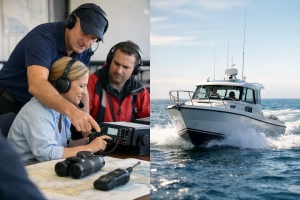
A handheld VHF set in the wrong hands can create confusion at exactly the moment a club needs clear, concise communication. That is why choosing from the top marine radio courses for clubs is not simply a booking decision. It is part of safe operations, recognised certification, and making sure members know what to do when routine traffic suddenly becomes an urgent call.
For sailing clubs, rowing clubs, powerboat groups, rescue teams and watersports centres, marine radio training tends to sit at the point where compliance and practical safety meet. A club may have good boats, capable instructors and sound procedures, but if members or staff are using marine VHF equipment without proper training, there is a gap. The right course closes that gap with recognised instruction, realistic scenarios and a clear route to competent radio use.
Contents
- 1 What clubs should expect from top marine radio courses
- 2 The main course type clubs should look for
- 3 How to assess the top marine radio courses for clubs
- 4 What makes a course genuinely useful for club operations
- 5 Who in a club should consider marine radio training
- 6 Choosing a provider in Scotland
- 7 The trade-off between convenience and depth
What clubs should expect from top marine radio courses
The strongest marine radio courses for clubs are usually built around the Short Range Certificate, often referred to as the SRC. For most club environments, this is the relevant qualification because it covers the operation of marine VHF radios fitted with Digital Selective Calling, along with voice procedure, distress alerts, urgency calls, safety traffic and routine communication.
That matters because club use is rarely limited to one tidy scenario. On one day, a radio may be used for launch coordination, race management and shore-to-boat communication. On another, it may be needed to report an incident, relay safety information or contact the Coastguard. Training needs to reflect that range.
A worthwhile course should therefore cover more than button pressing. It should explain what each channel is for, when DSC is appropriate, how to structure a call, what information to pass, and how to avoid creating unnecessary radio traffic. Clubs benefit most when candidates leave understanding both the equipment and the discipline that sits behind its use.
The main course type clubs should look for
RYA SRC training is usually the best fit
For most UK clubs, the benchmark option is an RYA-recognised Short Range Certificate course. This is generally the most suitable route because it is widely understood, relevant to leisure and small commercial marine operations, and focused on practical VHF use.
An RYA SRC course is particularly well suited to clubs with safety boats, committee vessels, patrol launches, training fleets or regular on-water events. It gives members and staff a qualification that is recognised and directly applicable to day-to-day marine communication.
That said, not every club needs the same volume of training. A small inland club with limited radio use may only need a handful of key personnel qualified. A busy coastal club running courses, races and rescue cover may need a wider pool of certified operators. The course itself may be the same, but the training plan around it will vary.
Online learning versus face-to-face delivery
Some clubs begin by asking whether online learning is enough. The answer depends on the course structure and the confidence of the candidates. Theory can often be introduced well through pre-course learning or supported online elements, especially for experienced boaters. However, many clubs still benefit most from face-to-face delivery, particularly where members have mixed levels of knowledge.
In-person training gives candidates the chance to practise radio procedure aloud, handle the equipment properly and correct mistakes before assessment. That is useful for beginners, but it is equally useful for experienced water users who have picked up informal habits over time. A qualified instructor can tighten procedure quickly and bring everyone onto the same standard.
How to assess the top marine radio courses for clubs
Clubs should be cautious about choosing a course on price alone. Cost matters, especially for volunteer-led organisations, but poor-quality instruction can lead to weak understanding, failed assessments or members who hold a certificate without real confidence in using the radio under pressure.
A better starting point is accreditation. If the course is delivered through an RYA Recognised Training Centre, that gives clubs a clear level of assurance around syllabus, instruction and assessment standards. Beyond that, it is worth looking at whether the provider has practical experience with club environments rather than only private leisure bookings.
Delivery flexibility also matters. Some clubs are better served by open courses where individual members book onto scheduled dates. Others will find private group training more efficient, particularly if they want several instructors, coxswains, safety boat helms or committee members trained together. Group delivery often allows examples and scenarios to be tailored more closely to the club’s actual operation.
Location is another practical issue. Travelling to a training centre may suit individuals, but for clubs with larger groups, on-site delivery can be more efficient if the provider can attend the club or a nearby venue. That reduces downtime and can make attendance easier for volunteers who are fitting training around work and family commitments.
What makes a course genuinely useful for club operations
Realistic scenarios, not just exam preparation
Some candidates approach marine radio training as a certificate to get through. Clubs should expect more than that. A good course prepares people for the assessment, but it should also prepare them to use a radio properly during an event, a breakdown, a capsize response or a deteriorating weather situation.
That means scenario-based learning matters. Club candidates should practise routine calls, marina or harbour communication where relevant, and distress or urgency procedures in a way that feels operational rather than abstract. The aim is not to make radio use sound dramatic. It is to make correct procedure feel familiar.
Clear instruction for mixed-ability groups
Many clubs train mixed groups. Some candidates may be experienced sailors or powerboat helms. Others may be new volunteers, race officers or assistant instructors with very limited radio exposure. The best courses account for that difference without losing the room.
Strong instructors keep the technical content accessible while maintaining the standards required for recognised certification. That balance matters. If the course is too basic, experienced candidates disengage. If it is too technical too quickly, less confident candidates fall behind.
Relevance to the club’s actual equipment
Not every VHF set is identical. While core principles remain the same, candidates benefit when training reflects the kinds of fixed or handheld units they are likely to use. Clubs should ask whether practical sessions include equipment similar to their own set-up and whether DSC functions are covered clearly rather than rushed.
If a club operates both shore-based and vessel-based radios, that is worth discussing with the provider in advance. The training should still follow the recognised syllabus, but examples can be framed to match real operating conditions.
Who in a club should consider marine radio training
The obvious candidates are safety boat crews and instructors, but clubs often benefit from thinking more broadly. Committee boat teams, race management personnel, launch drivers, shore coordinators and senior volunteers may all need radio competence depending on how the club operates.
The right approach is usually role-based rather than blanket training for everyone. A club should look at who is expected to transmit, who may need to coordinate activity on the water, and who could be required to respond if an incident develops. Those are the people who should be prioritised.
It is also sensible to avoid relying on one or two qualified members. If only a very small number of people understand proper procedure, resilience becomes a problem. Holidays, illness or staff turnover can leave the club exposed at the wrong time.
Choosing a provider in Scotland
For Scottish clubs, logistics and local understanding often play a bigger role than they first appear to. Travel distances can be significant, volunteer availability may be limited, and seasonal operations can put pressure on training windows. A provider that can offer both centre-based and on-site options is often easier to work with than one rigid delivery model.
Clubs should also look for providers that understand regulated training, recognised awarding structures and the practical demands of marine environments. Marine radio training should not feel isolated from wider safety planning. In many clubs, it sits alongside powerboat qualifications, first aid requirements, rescue cover and general operational risk control.
An RYA Recognised Training Centre with experience delivering practical safety training can therefore be a strong fit. Where needed, providers such as SPR Training can support clubs with recognised marine radio instruction as part of a wider, compliance-led training approach.
The trade-off between convenience and depth
There is no single best format for every club. Open courses are convenient for sending one or two members at a time. Private delivery is often better for consistency across a team. Short-notice dates may solve an immediate need, but planned training ahead of the season tends to produce better attendance and less pressure.
The key is to avoid choosing the quickest option if it does not suit the club’s structure. Marine radio use is a live operational skill. Convenience matters, but competence matters more.
A good club course should leave candidates able to make a routine call without hesitation, send the right message in the right format, and understand what to do if the situation becomes serious. That is the standard worth paying for, and it is usually what separates a merely available course from one of the top marine radio courses for clubs.
If your club is reviewing its training plan for the coming season, marine radio is one area where a small investment in the right course can make day-to-day operations calmer and emergency response much clearer.