
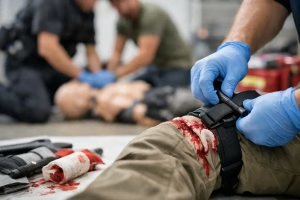
Severe bleeding does not leave much room for hesitation. In a workshop, on a building site, at a sports venue or during a roadside incident, the difference between a controlled response and a delayed one can be measured in minutes. That is why a haemorrhage control skills update matters for both qualified first aiders and experienced responders who may not have used these interventions recently.
For many teams, the issue is not whether they have been trained at some point. It is whether they can still assess catastrophic bleeding quickly, select the right equipment, and apply it correctly under pressure. Skills fade. Guidance evolves. Equipment changes. A short update can bring practice back to the standard needed in real incidents.
Contents
- 1 What a haemorrhage control skills update should cover
- 2 Why these skills need regular refreshers
- 3 Haemorrhage control skills update for different sectors
- 4 Key practical points that should be revisited
- 5 How often should training be updated?
- 6 Choosing the right update format
- 7 Making the update part of workplace preparedness
What a haemorrhage control skills update should cover
A useful update is not just a repeat of first aid basics. It should focus on high-consequence bleeding where immediate intervention is required before ambulance clinicians arrive. In practice, that means recognising catastrophic external haemorrhage, understanding when direct pressure is enough, and knowing when a haemostatic dressing or tourniquet is the safer option.
The update should also revisit scene assessment and personal safety. In higher-risk settings such as construction, forestry, equestrian work, marine activity and manufacturing, responders may be dealing with machinery, sharp tools, traffic, unstable ground or contaminated environments. Haemorrhage control starts before the dressing is opened. If the scene is not safe, the casualty and the responder are both at greater risk.
Good training also addresses communication. A responder controlling severe bleeding should be able to pass clear information to emergency services and colleagues – what happened, where the wound is, what interventions have been used, and how long a tourniquet has been in place. That sounds straightforward in a classroom. It is much harder when gloves are bloodied and the casualty is deteriorating.
Why these skills need regular refreshers
The main reason is simple: most people do not use haemorrhage control techniques often enough to retain confidence. Even competent first aiders can hesitate if they have not handled a tourniquet for a year or more. They may remember the theory but lose time second-guessing placement, tightening or escalation.
There is also the question of context. A standard workplace first aid qualification may include severe bleeding management, but some roles need more than a basic overview. Forestry teams, event medical staff, security personnel, sports coaches, outdoor instructors and pre-hospital practitioners may face incidents where catastrophic haemorrhage is a realistic risk. For those groups, periodic updates are not an extra. They are part of maintaining operational readiness.
Equipment familiarity is another factor. Not all bleed control kits are set up in the same way, and different workplaces stock different products. If staff have never opened the exact kit provided on site, there is a risk of losing valuable time during an emergency. Training should bridge that gap between certification and the actual contents of the workplace response bag.
Haemorrhage control skills update for different sectors
The right level of update depends on the environment and the likely mechanism of injury. An office-based first aider does not usually need the same level of scenario training as a responder on a farm, in a warehouse or on a vessel. That is not about reducing standards. It is about matching training to foreseeable risk.
In construction and industrial settings, crush injuries, lacerations and machinery incidents may shape the training focus. In rural and outdoor sectors, delayed access to emergency services can make early haemorrhage control even more important. In sport, equestrian and event settings, responders may need to manage severe bleeding in crowded, noisy or weather-exposed conditions. In marine contexts, movement, confined spaces and communication issues can complicate a straightforward skill.
This is why generic refresher sessions are not always enough. The strongest updates use realistic scenarios, workplace kit and role-specific decision-making. A nursery manager and a close protection operative may both need first aid training, but the haemorrhage risk profile is clearly different.
Key practical points that should be revisited
Direct pressure remains the first and most immediate intervention for many serious bleeding incidents. That part has not changed. What often needs practice is applying enough pressure, maintaining it, and reassessing whether bleeding has actually been controlled rather than assuming it has.
Tourniquet use is another area where updates are valuable. Responders should be clear on when a tourniquet is indicated, where it should be applied, and what effective tightening feels like. A loosely applied tourniquet is not a safer version of the real thing. It is a failed intervention that may delay proper treatment.
Haemostatic dressings also deserve hands-on revision. People often remember that they exist but not how thoroughly a wound cavity needs to be packed, how long pressure should be held, or when reassessment is required. In training, this should be practised repeatedly rather than discussed in passing.
A good update should also cover the practical realities around shock, casualty positioning where appropriate, thermal protection, and ongoing monitoring while waiting for handover. Bleeding control does not happen in isolation. It sits within the wider management of a seriously unwell casualty.
Common gaps seen during refresher training
One of the most frequent issues is delay in recognising catastrophic haemorrhage. Responders may treat a severe bleed as routine because they are trying to stay calm or work through a standard sequence too slowly. Another is uncertainty over kit selection – opening multiple dressings, searching for the tourniquet, or using the wrong item first.
There can also be overconfidence. Someone who completed a course months ago may believe they still have the skill at operational level, only to find that application speed and decision-making have dropped. That is not a criticism. It is normal, and it is exactly why structured refreshers are useful.
How often should training be updated?
There is no single answer that fits every organisation. It depends on risk exposure, staff turnover, existing qualifications and the level of responsibility held by the responder. For lower-risk workplaces, periodic practical refreshers alongside formal first aid requalification may be enough. In higher-risk sectors, more frequent updates can be justified, particularly where catastrophic bleeding is a credible threat.
As a working rule, employers should not rely only on the expiry date of a certificate. If staff are expected to use advanced bleed control equipment, carry trauma kits, or support lone and remote operations, their competence should be checked more regularly. Short, focused CPD sessions can be more effective than waiting several years between formal courses.
The same applies to instructors and experienced responders. Previous exposure is helpful, but it does not remove the need to refresh. Techniques become rusty, and guidance can shift over time.
Choosing the right update format
For some organisations, an on-site session is the best option because it allows staff to train with their own equipment, in their own environment, using scenarios that reflect actual hazards. For others, a dedicated training centre provides a cleaner setting for concentrated skills practice away from daily interruptions.
What matters most is not the venue but the quality of delivery. The session should be practical, supervised and aligned to recognised standards. It should also give learners enough time to repeat key interventions until they can perform them with confidence rather than just recognise them from a slide.
Where teams have mixed experience levels, a bespoke session is often the better choice. Newer first aiders may need stronger foundations, while experienced personnel may benefit from more demanding scenarios and decision points. Treating both groups exactly the same can leave one under-challenged and the other behind.
For employers across Scotland looking at workforce readiness, accredited and role-specific delivery usually provides the clearest value. Providers such as SPR Training can tailor updates around sector risk, existing certification and operational need, whether training is delivered in Airdrie or at client premises.
Making the update part of workplace preparedness
A haemorrhage control skills update works best when it sits within a broader emergency response plan. That includes checking where kits are stored, whether stock is in date, who is trained to use it, and how incidents will be escalated. There is little benefit in having a tourniquet on site if nobody can find it, nobody has practised with it, or managers assume somebody else is responsible.
Employers should also consider whether their current risk assessment still reflects the work being done. New machinery, lone working, public-facing events, seasonal activity and remote operations can all change the level of preparedness required. Training should follow risk, not habit.
The strongest organisations treat refreshers as part of competence maintenance rather than remedial action. That approach tends to build confidence, improve response speed and reduce the uncertainty that can affect even experienced staff in high-pressure incidents.
When severe bleeding occurs, nobody gets extra time to remember what they meant to revise. A short, well-run update now is often what makes a calm, effective response possible later.