
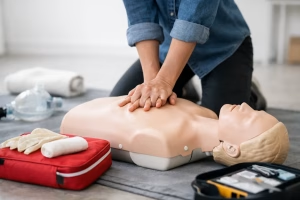
If your first aid certificate is close to expiring, leaving it until the last minute is where most problems start. Whether you are covering workplace compliance, meeting a contract requirement, or staying current in a hands-on role, knowing how to renew first aid certificate status properly helps you avoid gaps in cover and keeps your training relevant.
Renewal is rarely just a case of turning up for any course with a similar name. The right option depends on the qualification you hold now, when it expires, the standards your employer works to, and the level of risk in your setting. A workplace first aider in an office may need something different from a forestry instructor, nursery practitioner, sports coach, or marine professional.
Contents
- 1 How to renew first aid certificate without losing valid cover
- 2 Check what your role and sector actually require
- 3 Book early if your certificate is due to expire
- 4 Choose an accredited provider, not just the cheapest course
- 5 What to bring and what to expect on the day
- 6 What happens if your certificate has already expired?
- 7 Keep your first aid skills current between renewals
- 8 A sensible renewal process for employers
How to renew first aid certificate without losing valid cover
The first step is to check exactly which certificate you hold. Many people remember the broad subject but not the awarding body, course level, or expiry date. Look at your certificate and confirm the full course title, the date achieved, and the date it runs out. In most cases, first aid certificates are valid for three years, but there are exceptions depending on the course and sector.
You should also confirm whether your qualification is regulated or industry-specific. Emergency First Aid at Work, First Aid at Work, Paediatric First Aid, Basic Life Support, outdoor first aid, and specialist pre-hospital qualifications each sit in different contexts. Some are driven by workplace legislation, some by insurers, some by governing bodies, and some by employer policy.
Once you know what you currently hold, the next question is whether you need a full requalification or a shorter refresher. This is where it depends. For some regulated first aid qualifications, there is no shortcut at expiry and you must complete the full course again. For others, an annual refresher is recommended during the three-year period, but it does not replace formal renewal when the certificate ends.
That distinction matters. A half-day update can be useful for confidence and skills retention, but if your certificate has expired and your workplace requires a current regulated qualification, only the correct renewal route will meet compliance.
Check what your role and sector actually require
Before booking anything, match the course to the role rather than assuming your old certificate is still the right one. Job responsibilities change. So do risk assessments, client contracts, and inspection expectations.
If you are an employer, review your first aid needs assessment. The Health and Safety Executive framework means the number of first aiders and the level of training should reflect the hazards present, your workforce size, shift patterns, and whether staff work remotely or in higher-risk environments. A low-risk office setting may be adequately covered by Emergency First Aid at Work, while construction, manufacturing, agriculture, or remote outdoor work often need a fuller level of provision.
If you work with children, paediatric requirements are separate from standard workplace first aid. If you teach fitness, operate in equestrian settings, support events, or work on the water, a sector-specific course may be more appropriate than a generic refresher. The practical point is simple: renewing the wrong certificate does not solve the problem.
Book early if your certificate is due to expire
The best time to renew is before the expiry date, not after it. That gives you more choice on dates, location, and delivery format, and it reduces the chance of being left without valid cover.
For individual learners, early booking avoids having to stop work in settings where an in-date certificate is expected. For businesses, it helps with staffing and compliance planning. If several team members expire at the same time, arranging a private course on site can be more efficient than sending people out separately, but that only works if you plan ahead.
A practical rule is to start checking dates a few months before expiry. That is especially useful if you need weekend training, a specific accredited provider, or a course delivered at your premises in Scotland. Waiting until the final week limits options and can leave you paying for availability rather than suitability.
Choose an accredited provider, not just the cheapest course
When people ask how to renew first aid certificate status, price often comes up early. Cost matters, but certification quality matters more. Your provider should be clear about the awarding body, course content, assessment method, duration, and whether the qualification meets the standard required for your workplace or sector.
A proper renewal course should include practical assessment and current guidance, not just a quick classroom recap. First aid training changes over time. Guidance around CPR, defibrillator use, catastrophic bleeding, and casualty management is updated periodically, so renewal is not box-ticking. It is your chance to refresh techniques that are easy to lose if they are not practised.
For employers, this is also where delivery format matters. Open courses suit individuals and small teams. On-site training can be more practical for larger groups, shift-based operations, schools, nurseries, clubs, and businesses that want examples tailored to their actual risks. In Scotland, local delivery can also make a real difference to attendance and continuity.
What to bring and what to expect on the day
Most renewal courses are straightforward if you arrive prepared. Bring photo identification if requested, wear suitable clothing for floor-based practical work, and expect to take part fully in scenarios such as CPR, recovery position, choking management, and dealing with bleeding, burns, shock, or medical emergencies.
If you have an old certificate, bring it if the provider asks for it. It may help confirm that you are on the right course, though many renewals are treated as full requalification programmes rather than simple updates. If you have any medical or mobility issues that affect practical participation, raise that in advance so reasonable arrangements can be discussed.
Do not assume prior experience means the course will be easy. Experienced staff often find renewal useful because it corrects habits that have drifted over time. Confidence is helpful, but assessment is based on current standards and competent performance.
What happens if your certificate has already expired?
An expired certificate does not always mean you need to start from zero in every sense, but it usually means you cannot present yourself as currently certificated until you complete the correct course. For workplace compliance, that gap can be significant.
If you are an employer and one of your appointed first aiders has lapsed, review your cover immediately. You may need to arrange temporary cover through other trained staff while renewal is completed. If several certificates have expired, your organisation may no longer meet the level of first aid provision identified in your needs assessment.
For individual learners, the practical answer is usually to book the appropriate course as soon as possible and avoid relying on informal experience as a substitute for certification. Some sectors, insurers, and clients are strict on dates. Close enough is not usually good enough.
Keep your first aid skills current between renewals
Renewing every three years is one part of competence, not all of it. Skills fade, especially if they are rarely used. Annual refresher training is widely recommended because it helps first aiders retain confidence and practise key interventions before the formal renewal point arrives.
This is particularly valuable in higher-risk settings or where staff may be first on scene. Construction teams, outdoor instructors, healthcare support staff, childcare providers, sports organisations, and event personnel often benefit from shorter updates focused on practical drills and scenario work.
For some teams, specialist CPD is also worth considering. Haemorrhage control, oxygen administration, airway management, anaphylaxis awareness, and trauma-focused updates may sit alongside the core certificate depending on the role. The right mix depends on your environment and foreseeable incidents.
A sensible renewal process for employers
For employers managing multiple certificates, the cleanest approach is to treat renewal as part of compliance planning rather than an admin task that gets chased when someone notices an expiry date. Keep a central record of qualification titles, expiry dates, and locations. Review it regularly against shift patterns, holiday cover, and changes in staffing.
It also helps to avoid having every certificate expire in the same month. Staggering training where possible gives more resilience. If one person leaves or is absent, you still have cover. For businesses with mixed operations, separate your training needs by function. Office staff, workshop teams, drivers, childcare staff, and field-based workers may all require different levels of first aid provision.
Working with a provider that can deliver both open courses and on-site options can simplify that process. Where teams have varied responsibilities, bespoke scheduling is often more practical than forcing everyone onto the same course calendar.
At SPR Training, this is typically where employers benefit most from a direct conversation before booking. Matching the certificate to the role avoids wasted training time and helps ensure the qualification stands up to workplace and sector requirements.
If your certificate is nearing expiry, act before it becomes urgent. A short check of what you hold, what your role requires, and when you can train is usually enough to keep things on track and your cover current.