
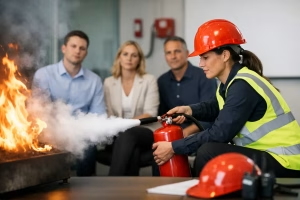
When the fire alarm sounds, people do not need a speech. They need clear direction, quick checks and someone who knows exactly what to do next. That is why understanding how to train workplace fire wardens properly matters. A fire warden is not there to replace the Fire and Rescue Service. They are there to support a safe evacuation, reduce confusion and help an employer meet its fire safety duties.
In many workplaces, the title varies. Some businesses use fire warden, others use fire marshal. The function is broadly the same, but the training should always reflect the actual site, the people on it and the risks involved. A small office in Airdrie will not need the same level of emphasis as a timber yard, workshop, nursery or mixed-use premises with contractors moving through it all day.
Contents
What workplace fire wardens need to do
Before deciding how to deliver training, it helps to be clear about the role. Fire wardens are usually responsible for supporting evacuation procedures, checking designated areas where safe to do so, helping staff and visitors move to assembly points, and reporting relevant information once outside. In some settings they may also have a role in identifying fire hazards, checking escape routes remain clear and feeding back on drill performance.
That means training should not be treated as a box-ticking exercise. If the only outcome is a certificate on file, the business has missed the point. Good training gives wardens confidence under pressure. It also gives managers a more reliable emergency response on site.
How to train workplace fire wardens for real conditions
The most effective approach combines formal instruction with site-specific practice. A recognised fire marshal or fire warden course provides the legal and procedural foundation. That usually covers the causes of workplace fire, how fire spreads, common control measures, evacuation principles, extinguisher awareness and the responsibilities of the nominated person.
That baseline is essential, but it is only the first part. Fire wardens also need to understand their own workplace layout, alarm arrangements, escape routes, assembly points and any local hazards. If your site stores fuel, batteries, chemicals or petrol cylinders, those issues need to be addressed directly. If you operate in healthcare, childcare or supported environments, the training also needs to consider those who may need assistance evacuating.
In practice, the best results come when employers pair accredited training with a clear local induction. The course teaches the role. The site briefing teaches how that role works in your building, with your staffing levels and your procedures.
Start with your fire risk profile
Not every workplace needs the same number of fire wardens or the same depth of scenario planning. A single-storey office with stable staffing is simpler than a multi-room factory with shift work, visitors and restricted areas. Training decisions should follow the findings of your fire risk assessment.
Look closely at occupancy levels, vulnerable persons, lone working, hot works, storage arrangements and any areas where fire could develop unnoticed. Also consider whether your wardens may need to coordinate evacuation across more than one floor or building. The greater the complexity, the more important practical drills and role clarity become.
Choose the right people, not just available people
A common mistake is to appoint whoever happens to be free. Reliability matters more than convenience. Fire wardens should be calm, communicative and physically able to carry out checks within the limits of the role. They should also be regularly present in the workplace. Someone who is often off site, travelling or home-based may not provide dependable cover.
It is sensible to train more than the bare minimum. Annual leave, sickness, shift patterns and staff turnover can all leave gaps. In larger premises, coverage by zone or department is often more practical than relying on one or two named individuals.
Cover the legal and practical basics
Training should explain the employer’s fire safety duties and where the fire warden fits into that wider arrangement. Wardens do not need to become fire safety advisers, but they do need to understand why evacuation procedures, housekeeping standards and reporting systems matter.
From there, the practical content should be straightforward. They need to know how to raise the alarm, what the alarm sounds like, what action to take on hearing it, which areas they are expected to check and when to stop checking and leave. That final point matters. Fire wardens should never put themselves at risk. Training must reinforce that evacuation support is the priority, not firefighting heroics.
If extinguishers are covered, keep the message realistic. Staff can be shown the types available and the principles of safe use, but using an extinguisher is always situation-dependent. In many workplaces, immediate evacuation is the right response.
Site-specific training makes the difference
A generic course can only go so far. Once wardens understand the principles, they need to walk the site. Show them call points, final exits, refuge points if applicable, assembly areas, panel locations and any compartments or fire doors that affect movement through the building.
This is also the stage to explain local complications. Perhaps one rear exit cannot be used during deliveries. Perhaps a workshop roller door is not an approved escape route. Perhaps a nursery must account for sleeping children, or a warehouse has seasonal layout changes that affect travel distances. These details shape real decisions during an alarm, so they should form part of training rather than being left to chance.
Train for people, not just buildings
Evacuation plans often look tidy on paper and become less tidy when real people are involved. Visitors may not know where to go. Contractors may ignore alarms because they assume it is a drill. New starters may freeze or follow the crowd in the wrong direction. Staff with mobility, hearing or cognitive needs may require planned support.
Fire wardens should be trained to spot these issues quickly and respond within procedure. That may include checking meeting rooms, toilets or quieter work areas, directing visitors to assembly points and understanding any personal emergency evacuation plans already in place. If your workforce includes the public, children or service users, training should reflect that reality.
Drills are part of training, not a separate admin task
A fire drill is one of the best ways to test whether your training is working. It shows whether wardens know their areas, whether routes stay usable and whether people actually respond as expected. It also highlights weak points that are easy to miss in a classroom.
To get value from drills, set a clear objective. You may want to test a full evacuation, a shift handover period or a scenario involving a blocked route. Afterwards, review what happened while it is still fresh. Did wardens sweep their areas properly? Were visitors accounted for? Did anyone re-enter the building too soon? Those lessons should feed back into refresher training and local procedure updates.
How often should workplace fire wardens be trained?
There is no single answer that fits every site. Initial training should happen before a person takes on the role. After that, refreshers should be based on risk, change and confidence, not just diary dates. Many employers opt for periodic refresher training to keep knowledge current, especially where staff turnover is high or the workplace has meaningful fire risks.
You should also revisit training after layout changes, process changes, refurbishment, new equipment installation or any incident that exposes a weakness. Even a near miss can justify an update. A warden trained three years ago for a simple office may no longer be properly prepared if that office now includes storage, charging points or shared tenancy arrangements.
Common gaps to avoid
Most problems are not caused by a total lack of training. They come from partial training. Wardens attend a course but never receive a site briefing. Drills take place but no one reviews them. Managers nominate one person per floor and forget about sickness cover. New hazards appear and procedures stay the same.
Another gap is assuming confidence equals competence. The loudest person in the room is not always the safest choice in an emergency. Good training should create consistency, so wardens follow procedure calmly rather than improvising.
For Scottish employers with multiple sites or operational teams, consistency across locations matters too. The core role can stay aligned, while local instruction covers each premises. Providers such as SPR Training often support this approach by delivering accredited fire marshal instruction alongside practical, on-site delivery that reflects how the business actually operates.
A well-trained fire warden should leave training knowing where to go, what to check, when to withdraw and how to help others do the right thing. If your current arrangements do not give them that level of clarity, that is the place to start.