
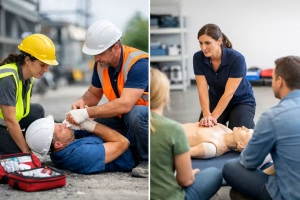
When you are booking training for a team, the real question is rarely whether first aid training is needed. It is usually where that training should happen. For many employers, deciding between onsite first aid versus centre training comes down to a mix of cost, disruption, risk profile and how closely the course needs to reflect day-to-day working conditions.
There is no single right answer for every organisation. A nursery, a forestry team, a gym, a fabrication workshop and an office may all need compliant first aid provision, but the most effective delivery model can look quite different in each setting. The best choice is the one that gives learners recognised certification, practical confidence and a course structure that works in operational terms.
Contents
- 1 Onsite first aid versus centre training – what is the difference?
- 2 When onsite training makes the most sense
- 3 The limits of onsite delivery
- 4 Why centre training still works very well
- 5 Onsite first aid versus centre training for compliance
- 6 Cost is not just the course fee
- 7 The learning experience matters more than convenience alone
- 8 How to choose the right option for your organisation
Onsite first aid versus centre training – what is the difference?
Onsite training means the instructor comes to your workplace or chosen venue and delivers the course to your group there. Centre training means learners attend a dedicated training venue on set dates, usually alongside delegates from other organisations.
At first glance, that can seem like a simple logistical difference. In practice, it affects far more than travel arrangements. It influences how examples are taught, how much time is lost to transport, whether the group can train together, how easily the course can be tailored and how suitable the learning environment is for concentrated practical work.
For employers in Scotland with mixed teams, multiple shifts or remote sites, those factors matter just as much as headline price.
When onsite training makes the most sense
Onsite delivery is often the strongest option when you need to train a group from the same business. If several staff members require the same qualification at the same time, bringing the course to your premises can reduce travel, simplify scheduling and keep everyone on a consistent standard.
It also allows the training to feel more relevant from the outset. A first aid session delivered in a warehouse, workshop, school or outdoor setting can reference the actual hazards staff deal with. That does not change the assessment standard, but it can improve how quickly learners connect the content to their role. A team working around machinery, vehicles, tools or members of the public tends to engage well when the scenarios reflect what they might genuinely face.
There is also a practical advantage for managers. Instead of sending people out to different dates or locations, the business can organise one delivery plan, one instructor timetable and one internal communication process. That is especially useful where compliance needs to be renewed across a department.
For some sectors, onsite training can support stronger discussion around emergency arrangements. Staff can think about first aid kits, access routes, welfare areas, incident reporting and emergency services access while standing in the environment where those decisions would actually be made.
The limits of onsite delivery
Onsite is not automatically better. It depends on the quality of the space and the way the day is managed. First aid training needs room for practical exercises, enough floor space for CPR work, minimal interruption and an environment where learners can focus properly.
If the training room is too cramped, too noisy or treated as a normal working area during the course, the quality of learning can drop. Staff being pulled away for calls, deliveries or routine tasks is a common issue. Training works best when people are allowed to attend it fully rather than trying to balance it with their usual shift.
There is also a numbers question. If only one or two people need certification, private onsite delivery may not be the most economical choice. In that situation, a centre-based open course is often the more sensible option.
Why centre training still works very well
Centre training remains a strong choice because it provides a dedicated learning environment. The room is already set up for practical instruction, equipment is in place, and learners are away from the distractions of their normal workplace. That can make a real difference, particularly for courses that require concentration, discussion and repeated hands-on practice.
For individual learners, centre courses are often the simplest route. If one employee needs Emergency First Aid at Work, paediatric first aid or a refresher, booking a place on a scheduled course can be quicker and more cost-effective than arranging a private session.
Mixed-delegate courses also have value. Learners hear questions from other sectors, compare approaches and often gain a wider understanding of how first aid principles apply across different workplaces. That can be particularly useful for self-employed professionals, small businesses and clubs that do not need a full group booking.
A training centre can also offer consistency. Equipment, layout and delivery conditions are controlled, which supports a smooth course experience. For accredited training, that matters. Learners need clear instruction, proper assessment and a setting that supports both.
Onsite first aid versus centre training for compliance
From a compliance point of view, the priority is not whether the course is delivered onsite or at a centre. The priority is whether the qualification is appropriate, recognised and delivered correctly. Employers need to match first aid provision to their needs assessment, workplace hazards and staff roles.
That said, delivery format can affect how easy compliance is to maintain. Onsite group bookings can help businesses bring several staff into date at once, which makes certification records easier to manage. Centre courses can help when renewals are staggered or when only a few staff need training.
The key is to start with the course requirement, not the venue preference. If the workplace needs First Aid at Work, paediatric provision, forestry-specific content or basic life support, the delivery method should support that requirement rather than drive it.
Cost is not just the course fee
Many buyers compare onsite and centre training purely on the quoted price. That can be misleading. The true cost includes travel time, mileage, time away from productive work, shift cover and the administrative time needed to get people booked and attended.
For larger groups, onsite training often becomes better value because one instructor can train multiple staff in one visit. For individuals or very small numbers, centre training usually works out cheaper.
There is also the cost of disruption to consider. Sending six employees to a centre may mean six separate travel arrangements and a full day away from site. Running that same course onsite may reduce lost time before and after the session. On the other hand, if your site cannot offer a suitable training space, trying to make onsite work can create its own inefficiencies.
The learning experience matters more than convenience alone
Convenience should not be the only deciding factor. First aid training is practical, assessed and safety-critical. The best course is the one learners will remember and apply under pressure.
Onsite sessions can create stronger workplace relevance. Centre sessions can create stronger focus. Neither outcome is guaranteed. It depends on planning, instructor quality and whether the training format suits the group.
If your team works together closely and may respond to incidents collectively, training together onsite can be particularly useful. If learners are attending from different roles or need a straightforward individual booking, centre delivery may produce a cleaner, less disruptive experience.
For specialist sectors, relevance becomes even more important. Outdoor staff, childcare providers, sports professionals and marine teams often benefit from delivery that reflects their operating environment and likely incidents. In those cases, a provider with sector-specific course options and flexible delivery can make the decision much easier.
How to choose the right option for your organisation
Start with four practical questions. How many people need trained? What qualification do they need? Can your premises support uninterrupted practical teaching? How much operational disruption can you realistically absorb?
If you have a group to train, a suitable room and a clear need to align content with your workplace setting, onsite delivery is often the better fit. If you have one or two learners, limited space or a need for quick access to scheduled dates, centre training is often the more efficient route.
It is also worth thinking beyond the immediate booking. Some organisations benefit from a blended approach over time – onsite courses for full-team renewals and centre places for new starters, late renewals or specialist add-on qualifications. That is often the most practical model for growing businesses or teams with staff turnover.
A provider with both options can help you choose on operational grounds rather than forcing you into one format. That flexibility is often what businesses need most. At SPR Training, that means employers across Scotland can match accredited first aid provision to their team size, sector and site realities rather than trying to make one fixed model fit every situation.
The right training venue is the one that helps people learn properly, meet the required standard and respond with confidence when something goes wrong. If you begin with that goal, the decision usually becomes much clearer.