
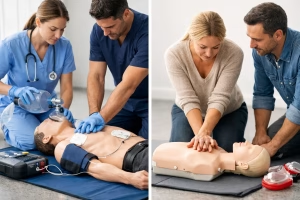
If you are comparing a bls course vs cpr course, the first thing to clear up is that they are not always competing options. In many settings, CPR is part of BLS. The real question is usually whether you need a general lifesaving course for basic emergency response, or a broader, more clinically structured programme designed for workplace or healthcare use.
That distinction matters when you are booking training for staff, renewing certification, or trying to meet a role-specific requirement. A nursery worker, gym instructor, site supervisor and healthcare assistant may all need life support skills, but they do not necessarily need the same course content, assessment level or certification standard.
Contents
- 1 BLS course vs CPR course – the core difference
- 2 Who usually needs a CPR course?
- 3 Who usually needs a BLS course?
- 4 What is covered in each course?
- 5 Certification and compliance considerations
- 6 BLS course vs CPR course for workplaces
- 7 Which course is better for individuals?
- 8 Questions to ask before you book
- 9 The right course is the one that fits the risk
BLS course vs CPR course – the core difference
A CPR course is usually focused on cardiopulmonary resuscitation itself. That means recognising cardiac arrest, calling for help, giving chest compressions, delivering rescue breaths where appropriate, and using an automated external defibrillator, often referred to as an AED. In some courses, the scope stays close to those essentials.
A BLS course, or Basic Life Support course, normally covers CPR but goes further. It often includes the full initial response to a casualty who is unresponsive or not breathing normally, including scene safety, primary assessment, airway management, recovery position, choking response and coordinated use of an AED. Depending on the provider and qualification, it may also place greater emphasis on team response, record keeping, infection control and professional duty of care.
So when people ask about bls course vs cpr course, the simplest answer is this: CPR is a skill set, while BLS is often a wider training framework that includes CPR as one element.
Who usually needs a CPR course?
A CPR course is often suitable for people who need clear, practical emergency skills without a wider qualification framework. That can include sports coaches, personal trainers, community group leaders, voluntary staff and members of the public who want confidence in an emergency.
It can also be useful for workplaces that want staff awareness training alongside a broader first aid provision already in place. For example, a business might have appointed first aiders with regulated first aid at work certification, but still want additional staff to know how to recognise cardiac arrest and start CPR before the first aider arrives.
The main advantage is simplicity. A focused CPR course can often be delivered in less time, with less administrative burden, while still teaching skills that make a real difference in the first critical minutes.
The trade-off is scope. If the role involves regular responsibility for patients, service users, pupils, clients or higher-risk environments, a CPR-only course may not be enough.
Who usually needs a BLS course?
A BLS course is more commonly required where staff have a defined duty to respond to medical emergencies as part of their work. That often includes healthcare settings, dental practices, care environments, certain education roles, and organisations working with vulnerable people.
BLS training is also often preferred where employers need a more structured and auditable approach to competence. If you are responsible for compliance, it helps to have a course with clear learning outcomes, practical assessment and certification that matches the risk profile of the role.
In some sectors, BLS is not just preferred but expected. Healthcare professionals, carers and clinical support staff may need annual refreshers in Basic Life Support because their working environment makes immediate response more likely, and because their employer or regulator expects current evidence of training.
For non-clinical workplaces, a BLS course may still be the better fit where there is a higher public interface, remote working, lone working or an elevated chance of delayed emergency services access.
What is covered in each course?
Course content varies by awarding body, training provider and sector, so it is worth checking the actual syllabus rather than relying on the course title alone.
A CPR course will usually cover recognition of cardiac arrest, emergency action steps, adult CPR, and AED use. Some providers also include choking and recovery position, particularly where the course is aimed at the general public or workplaces.
A BLS course will generally include those same CPR elements, but it is more likely to cover the wider chain of survival, structured casualty assessment, airway considerations, safe response priorities and age-specific variations where relevant. In healthcare-linked settings, it may also include bag-mask awareness, teamwork in resuscitation, and legal or professional considerations around emergency care.
That means two courses with similar practical content can still feel quite different in delivery. CPR training is often designed around immediate action and confidence. BLS training is more likely to be framed around role responsibility, procedure and repeatable competence.
Certification and compliance considerations
For employers, the certificate matters almost as much as the content. A short CPR awareness session may be entirely appropriate for internal skills development, but it may not meet an external requirement, insurer expectation or sector policy.
A BLS course is more likely to sit within a recognised compliance framework, especially when delivered by an accredited provider. That is particularly relevant for organisations that need training records for inspections, audits or contractual obligations.
This is where course selection often becomes less about preference and more about evidence. If a regulator, governing body, client contract or employer policy specifies Basic Life Support, then booking a CPR-only course could leave a gap. Equally, if a role only needs CPR and AED awareness, a broader BLS course may add time and cost without clear operational benefit.
The practical point is straightforward: match the certificate to the requirement, not just the course title.
BLS course vs CPR course for workplaces
For a typical office, warehouse, retail unit or small business, the right answer depends on existing first aid cover and risk assessment. If designated first aiders already hold Emergency First Aid at Work or First Aid at Work, a CPR course for wider staff can be a sensible way to strengthen emergency response across the team.
In higher-risk environments such as construction, manufacturing, outdoor work and remote operations, employers often need to think beyond minimum coverage. Delays in access, heavy machinery, public access, physical exertion and lone working can all change what is proportionate. In those cases, broader BLS training may be more appropriate for selected staff, particularly supervisors or team leads.
For healthcare, care and education settings, BLS is more often the safer choice because the expectation of response is greater and the duty of care is clearer. A CPR-only course can still be useful as supplementary training, but it may not satisfy the operational need on its own.
Which course is better for individuals?
Neither course is automatically better. It depends on why you are training.
If you want practical lifesaving confidence for everyday situations, a CPR course can be an accessible starting point. It gives you a focused set of actions you can remember under pressure, and that simplicity has value.
If you work in a role where emergency response forms part of your responsibilities, a BLS course is often the stronger option. It provides more context, more structure and a qualification that is more likely to be recognised by employers.
If you are changing sector, applying for a new role or returning to work after a break, it is worth checking what the employer actually asks for. People often book a CPR course assuming it will cover all bases, then find the vacancy or placement specifically requires Basic Life Support.
Questions to ask before you book
Before choosing between the two, ask what the role requires, whether there is a formal certification standard, how long the certificate remains valid, and whether annual refreshers are expected. You should also check the age group covered if your work involves children or infants, as adult-only training may not be enough.
Delivery format matters as well. Some organisations need training on site to reduce disruption, while others prefer staff to attend an accredited training centre. What matters most is that the course includes proper practical instruction and assessment, not just a theory overview.
For businesses across Scotland, that often means choosing a provider that can deliver recognised, role-specific training without turning a straightforward requirement into something overcomplicated.
The right course is the one that fits the risk
The comparison of bls course vs cpr course is really a question of scope, responsibility and evidence. CPR training teaches a critical intervention. BLS training usually places that intervention within a wider emergency response standard.
If you are booking for a team, start with the risk assessment and the compliance requirement. If you are booking for yourself, start with the job role you have now, or the one you want next. A good provider should be able to tell you plainly which course matches that need.
At SPR Training, that practical fit matters. The best course is not the longest one or the cheapest one. It is the one that gives you the right level of skill, the right certificate, and the confidence to respond properly when someone needs help.