
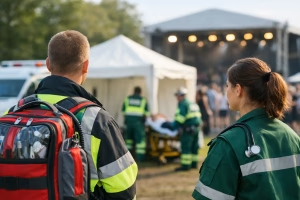
A busy event can change pace in seconds. A child trips on uneven ground, a steward collapses with heat exhaustion, or an attendee with a known condition suddenly needs urgent care. If you need to set up event medical cover, the right plan is not just about having someone on site with a first aid bag. It is about matching medical provision to the real risks of the event, the crowd, the site and the response time available.
For organisers across Scotland, that usually means balancing duty of care, practical logistics and budget. It also means understanding that event medical cover is rarely one-size-fits-all. A village gala, a football tournament, a motorsport gathering and a music event may all need cover, but not to the same level.
Contents
- 1 What does it mean to set up event medical cover?
- 2 Start with a realistic risk assessment
- 3 Match the medical team to the event
- 4 Site layout can strengthen or weaken your cover
- 5 Equipment should reflect likely incidents
- 6 Communication and escalation need to be clear
- 7 Documentation is part of good practice
- 8 Cost matters, but cheap cover can become costly
- 9 When to review your plan and increase cover
What does it mean to set up event medical cover?
To set up event medical cover properly, you need to decide what level of medical support is required, who will provide it, where they will be positioned, what equipment is needed and how they will respond if an incident escalates. Good cover supports minor injuries and illness, but it must also account for major trauma, safeguarding concerns, missing persons procedures, ambulance access and communication with emergency services.
That planning should sit within the wider event management process. Medical cover is connected to stewarding, traffic routes, site layout, fire safety, welfare provision and emergency procedures. If those parts are planned in isolation, gaps appear quickly.
Start with a realistic risk assessment
The first step is not hiring the nearest available team. It is assessing the event properly. Crowd size matters, but it is only one part of the picture. A smaller event with alcohol, temporary structures and difficult vehicle access may need more careful planning than a larger, low-risk daytime gathering.
Your risk assessment should consider the type of audience, expected age range, site conditions, weather exposure, activity risks, duration, time of day and whether alcohol or catering are involved. You should also look at access and egress routes, distance from local ambulance resources and whether the event is in a remote or rural area.
In Scotland, that last point can make a significant difference. If statutory ambulance response may be delayed due to location, traffic or terrain, the event may need a higher level of on-site capability. The same applies where forestry, marine, equestrian, motorsport or outdoor adventure elements are involved.
Match the medical team to the event
A common mistake is to ask for “a first aider” without defining the actual requirement. The right staffing model depends on risk. For a low-risk community event, trained first aiders may be appropriate. For higher-risk events, you may need a mix of first aiders, ambulance staff, technicians, nurses, paramedics or a dedicated event medical coordinator.
Competence matters more than job title alone. Staff should be trained for the environment they are working in and clear on their scope of practice. A sports event, for example, may need practitioners who are confident dealing with fractures, head injuries and spinal precautions. A family festival may require a stronger focus on minor injuries, dehydration, safeguarding and lost child procedures.
It is also worth considering resilience. If one team member is tied up with a patient for thirty minutes, what cover remains for the rest of the site? A plan that looks adequate on paper can become thin very quickly once the first incident occurs.
Site layout can strengthen or weaken your cover
Where your medical team is based matters almost as much as who is on duty. If the post is hidden behind barriers, hard to reach from the main arena or blocked by parked vehicles, response times suffer. The treatment area should be easy to access for the public, clearly briefed to staff and positioned with ambulance access in mind.
At larger events, a single fixed post may not be enough. Roaming responders, cycle responders or multiple treatment points may be more suitable where crowds are spread across a wide site. The layout should also consider privacy, shelter, lighting, hygiene arrangements and a safe area for clinical waste if relevant.
This is where practical event experience matters. A map may show a clear route, but on the day that route can be blocked by stalls, queues or temporary fencing. Walk the site in advance and test assumptions.
Equipment should reflect likely incidents
A basic first aid kit is not an event medical plan. Equipment needs to match the identified hazards, the level of staff on site and the anticipated patient presentations. For some events, that may mean dressings, cooling supplies and a treatment couch. For others, it could include oxygen, airway adjuncts, trauma kits, defibrillators, evacuation equipment and communications kit.
Defibrillator provision deserves particular attention. If your event is large, physically demanding or aimed at older participants, rapid access to an AED should be part of the conversation. The same applies where response from public services may not be immediate.
There is always a balance to strike. Over-specifying equipment can be expensive and unnecessary. Under-specifying it can leave a competent team unable to manage foreseeable incidents. The decision should come back to risk, not guesswork.
Communication and escalation need to be clear
When organisers set up event medical cover, they sometimes focus heavily on the treatment element and not enough on command and communication. A capable team still needs a clear reporting line, a reliable way to be contacted and agreed escalation procedures.
Stewards, security staff and event managers should know how to call for medical assistance, what information to provide and when to bypass internal reporting and dial 999. Radio channels, call signs, rendezvous points and ambulance access routes should all be agreed before the event opens.
You should also document what happens after first contact. Who meets the ambulance crew? Who clears access routes? Who records the incident? Who manages crowd control nearby? These details reduce confusion when pressure rises.
Documentation is part of good practice
Medical provision should be documented in the event plan, not arranged informally by text message the week before. You need written confirmation of the level of cover, hours of operation, named provider, incident recording arrangements and any relevant insurance or certification details.
That matters for compliance, but it is also operationally useful. If an incident is reviewed later, clear documentation helps show that decisions were considered and proportionate. It also helps if local authorities, venues or partner organisations ask what provision is in place.
For recurring events, post-event review is just as important. Look at incident numbers, treatment types, pressure points and any delays in response. That review will often show whether the cover was appropriate or whether changes are needed next time.
Cost matters, but cheap cover can become costly
Most organisers have a budget, and event medical cover has to sit within it. Still, the cheapest option is not always the most economical. Inexperienced providers, vague staffing commitments or poor equipment standards can create risk that far outweighs the initial saving.
Ask practical questions. What qualifications do staff hold? What event experience do they have? What equipment is included? How is cover adjusted if crowd numbers increase? What is the contingency if a team member becomes unavailable? Clear answers usually indicate a provider that understands event operations rather than simply filling a booking.
For some organisations, there is also value in combining event cover with workforce training. A venue team, club committee or sports organisation that invests in accredited first aid training may be better placed to support safe operations alongside external event medical staff. That kind of preparation often improves response in the first crucial minutes.
When to review your plan and increase cover
A medical plan should be revisited if any significant part of the event changes. An increase in ticket sales, later finish time, hotter weather forecast, change of venue or addition of alcohol can all alter the risk profile. The same is true if vehicle movements, water access or higher-risk activities are introduced after the original planning stage.
This is one reason early planning helps. Leaving medical provision until the final days before an event makes it harder to adjust staffing, source suitable equipment or brief everyone properly. It also increases the chance that organisers accept cover that is merely available, rather than cover that is genuinely suitable.
For organisers who run public, sporting or workplace events across Scotland, the most reliable approach is practical and evidence-based. Assess the real risks, choose competent people, plan the site properly and make sure everyone understands how the medical response fits into the wider event operation. If you do that, you are far more likely to provide cover that stands up when it is actually needed.
If you are planning an event and unsure what level of provision is reasonable, start by asking the hard operational questions early. Good medical cover begins there, long before the first patient appears.