
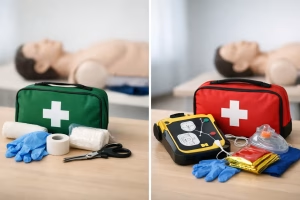
A lot of employers only ask the question when they need a certificate quickly. That is usually the wrong moment to decide. If you are working out how to choose EFAW or FAW, the better approach is to start with your actual workplace risks, your staffing levels and what kind of incidents a first aider may realistically have to manage.
Both qualifications are recognised workplace first aid courses, but they are not interchangeable. Choosing the right one affects compliance, cover arrangements and, more importantly, how prepared your team will be when something goes wrong.
Contents
- 1 How to choose EFAW or FAW for your workplace
- 2 Start with a first aid needs assessment
- 3 When EFAW is usually the right choice
- 4 When FAW is usually the better option
- 5 How risk level changes the answer
- 6 Think about practical coverage, not just certification
- 7 Cost, time and suitability
- 8 Questions to ask before booking
- 9 Choosing with confidence
How to choose EFAW or FAW for your workplace
The difference starts with course level and scope. EFAW stands for Emergency First Aid at Work. It is a one-day course designed for lower-risk settings where the first aider may need to provide immediate support for common workplace incidents while waiting for emergency services, or before further help is available.
FAW means First Aid at Work. It is a more comprehensive three-day qualification. It covers a wider range of injuries and medical emergencies in greater depth and is generally more suitable where risk is higher, where there are larger teams, or where the first aider may need to manage an incident for longer.
If your workplace has relatively straightforward hazards, such as a small office with low accident history, EFAW may be enough. If you operate in construction, manufacturing, warehousing, forestry, engineering or other environments with more serious injury potential, FAW is often the more suitable choice.
That said, there is no universal rule that one industry always needs one course and another does not. The right answer comes from your first aid needs assessment.
Start with a first aid needs assessment
Before booking any course, look at what the law expects you to consider. Your first aid provision should reflect the nature of your work, the hazards present, the number of people on site and practical factors such as shift patterns, lone working, travel and remote locations.
A needs assessment should ask sensible operational questions. What injuries are most likely? How quickly could an ambulance reach the site? Are there members of the public on the premises? Do you have young workers, expectant mothers or staff with known medical conditions that may affect first aid planning? Are staff spread across multiple floors, vehicles or work areas?
For a small, low-risk business with a handful of staff all working standard daytime hours, one EFAW-trained person may be proportionate. In a larger site with machinery, manual handling risks, hot works or cutting equipment, that level of provision may fall short even if it technically looks cheaper and quicker to arrange.
The course should fit the environment, not the other way round.
When EFAW is usually the right choice
EFAW is often suitable for low-hazard workplaces where the main requirement is to have someone trained to give immediate help in an emergency. Typical examples include offices, small retail premises, community venues and some customer-facing businesses with limited physical risk.
On the course, learners are trained to deal with key incidents such as an unresponsive casualty, CPR, use of an AED, choking, bleeding, shock and minor injuries. For many smaller organisations, that provides a practical baseline and meets the need for prompt first aid support.
EFAW can also work well where several staff need basic coverage across shifts or departments. In some businesses, training more people to EFAW level gives broader resilience than relying on one or two FAW holders who may be absent.
The trade-off is depth. EFAW is shorter for a reason. It does not cover the wider range of conditions and injury management included in FAW, and it may not be enough where incidents are likely to be more complex.
When FAW is usually the better option
FAW is generally the stronger fit for higher-risk workplaces and for employers who need a more capable in-house response. The course gives learners broader knowledge and more time to practise assessment and treatment skills.
This matters in settings where first aiders may face fractures, crush injuries, burns, eye injuries, major bleeding or medical emergencies that require more sustained management. It also matters where emergency services may take longer to reach the casualty, such as rural sites, large industrial premises or outdoor work locations.
FAW is often the sensible choice for construction firms, factories, workshops, logistics operations, estates teams, agricultural settings and active site environments where tools, vehicles and hazardous processes are part of daily work.
There is also a staffing argument for FAW. In larger organisations, a fully trained first aider may be expected to take a lead role in an incident, support reporting and handover, and manage a broader range of scenarios with confidence. That added competence can make a real difference during the first few minutes.
How risk level changes the answer
If you are unsure how to choose EFAW or FAW, risk level is the clearest starting point. Lower-risk does not mean no risk, but it usually means injuries are less severe and easier to manage until further help arrives. Higher-risk means the consequences of an incident are potentially more serious, and that changes the level of first aid provision you should consider.
A small accountancy office and a busy joinery workshop may employ the same number of people, but they do not have the same first aid needs. The office might reasonably rely on EFAW-trained staff. The workshop may need FAW-trained personnel because the possible injuries are more significant.
The same principle applies within a single business. Head office might be low risk, while warehouse staff or field teams need a higher level of cover. One course choice does not always suit every department.
Think about practical coverage, not just certification
It is common to focus on which certificate to book and overlook whether the cover will actually work in practice. A compliant course choice on paper can still leave gaps if the trained person is off sick, on annual leave, travelling between sites or working different hours from the rest of the team.
That is why staffing patterns matter. If your premises operate early and late shifts, or if key staff work alone, you may need more trained people than you first assumed. In some workplaces, the best solution is a combination: several EFAW-trained staff for broad day-to-day coverage, alongside FAW-trained personnel in higher-risk roles or areas.
This is also relevant for businesses with visitors, contractors or members of the public on site. Your first aid planning should reflect everyone who may be affected by an incident, not just your direct employees.
Cost, time and suitability
Some employers start from cost and duration. EFAW is quicker and less expensive than FAW, so it can be tempting to default to that option. But first aid training should be proportionate to risk, not chosen purely because it is easier to schedule.
A cheaper course that leaves your team underprepared is not good value. Equally, putting every employee through FAW where EFAW would be suitable may not be the best use of time or budget either.
The sensible approach is to match the course level to the role. If you have a mixed operation, different teams may need different qualifications. That is often more efficient than trying to force one standard across the entire organisation.
Questions to ask before booking
Before making a decision, ask who needs to be covered, what hazards they face and how serious a likely incident could be. Consider whether staff work in remote parts of Scotland, whether they travel, whether machinery or hazardous materials are involved and how quickly professional medical help could realistically arrive.
Also consider refreshers and requalification planning. First aid provision is not a one-off purchase. Certificates expire, staff leave, roles change and risks evolve. A good training decision should still make sense a year or two from now.
For employers who want a practical route through that decision, an accredited provider can help map the course level to the workplace rather than simply selling the shortest option. That is particularly useful for businesses with multiple sites or sector-specific risks.
Choosing with confidence
The best answer to how to choose EFAW or FAW is usually straightforward once you strip it back to the real working environment. If the workplace is low risk and the likely need is immediate emergency support, EFAW may be entirely appropriate. If the hazards are greater, the team is larger, the site is more complex or the potential injuries are more serious, FAW is often the better fit.
For many organisations, the strongest decision is not about choosing the cheapest course or the highest-level course. It is about choosing training that matches the job, the people and the risks you are responsible for managing. If that decision is made carefully, the certificate is not just a requirement met. It becomes part of a safer, better-prepared workplace.