
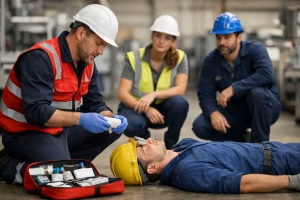
A slip near a wash station, a crush injury on a production line, a burn in the packing area – factory incidents rarely arrive with much warning. That is why first aid training for factory staff needs to reflect the actual hazards on site, not just a generic classroom exercise. In manufacturing settings, the difference between basic awareness and properly applied first aid can affect the outcome of an injury in the first few minutes.
Factories present a particular mix of risks. Staff may be working around machinery, heat, sharp tools, chemicals, vehicles, confined walkways and repetitive manual tasks, often across multiple shifts. A suitable training plan has to take account of that environment, the size of the workforce and how quickly help can realistically reach an injured person.
Contents
- 1 Why factory environments need role-specific training
- 2 What employers should consider before booking training
- 3 First aid training for factory staff and legal duties
- 4 What good factory first aid training should cover
- 5 Common mistakes factories make
- 6 Building a training plan that works on the ground
- 7 First aid training for factory staff is part of wider safety culture
Why factory environments need role-specific training
Workplace first aid is often discussed as if one course suits every setting. In practice, factories need a more considered approach. The hazards in a warehouse office are not the same as those on a fabrication floor, food production line or engineering workshop.
Staff may need to respond to severe bleeding, burns, fractures, crush injuries, eye contamination, fainting, seizures or cardiac arrest. Even where incidents are minor, the first person on scene still needs to know how to assess danger, protect themselves, contact emergency services and provide immediate care without making matters worse.
That is where first aid training for factory staff becomes more than a compliance task. It helps create a workforce that can respond calmly, communicate clearly and support casualties until further help arrives. For employers, that matters both from a duty of care perspective and from a practical operational one.
What employers should consider before booking training
The right course depends on your risk profile. A low-risk assembly space with a small team may not need the same level of cover as a large manufacturing facility with machinery, forklifts and hazardous substances. The starting point is always a proper first aid needs assessment.
This should look at the type of work being carried out, common hazards, accident history, number of employees, shift patterns, lone working, remoteness of certain areas and the time it may take for emergency services to reach the casualty. If you operate across several units or buildings, access and communication between departments also matter.
There is also the question of coverage. Training one or two staff members may satisfy the minimum on paper, but it can leave gaps during holidays, sickness, staff turnover or night shifts. In many factory settings, a broader spread of trained personnel across departments is the more workable option.
First aid training for factory staff and legal duties
Employers in Great Britain have a duty to provide adequate and appropriate equipment, facilities and personnel to ensure employees receive immediate attention if injured or taken ill at work. That duty sits alongside wider health and safety responsibilities and should be based on the findings of your risk assessment.
Adequate and appropriate does not always mean the same thing from one site to the next. A small premises with low hazards may be adequately covered by appointed persons and basic arrangements. A busier or higher-risk factory will often require trained first aiders, suitable equipment, clear reporting processes and regular refreshers.
The training itself should be recognised, relevant to the workplace and delivered in a way that staff can apply on site. That last point is often overlooked. If the content feels too detached from daily operations, retention tends to drop and confidence goes with it.
Choosing between emergency first aid and fuller workplace cover
For some factories, Emergency First Aid at Work may be suitable for selected staff where risks are relatively straightforward. In other cases, First Aid at Work is the better fit because it provides a broader level of knowledge and practical response capability.
It depends on the nature of the tasks, the seriousness of potential incidents and how many people may need support at any given time. Where machinery, burns risks, chemicals or larger teams are involved, employers often find that fuller training gives them stronger operational cover.
A blended approach can also work. You may train key personnel to a higher level while giving additional awareness training to supervisors or team leaders in other areas. That can improve early response without overcomplicating the training plan.
What good factory first aid training should cover
A relevant course should teach more than a checklist. Factory staff need to understand how to assess an incident scene, manage risk and provide immediate assistance within the limits of their training. That includes dealing with unconscious casualties, CPR, use of an AED, choking, bleeding, shock and common workplace injuries.
In a factory setting, practical scenarios make a real difference. Staff are more likely to retain knowledge when they have worked through examples that resemble their own environment – for instance, a casualty trapped near equipment, a colleague with a hand injury, or a burn sustained during processing work.
Training should also reinforce incident communication. Who calls for help, who meets emergency services, where is the nearest first aid kit, how are accidents reported, and what happens if the trained first aider is on another part of the site? These are simple questions, but they often determine how effective the response will be.
Confidence matters as much as certification
A certificate is important, but confidence under pressure is what employers are really relying on. Staff who have had hands-on instruction and clear, competent feedback are more likely to step forward when something happens.
That is one reason on-site delivery can be useful for manufacturing businesses. Training in the actual workplace allows examples, access points and emergency arrangements to be discussed in context. It also reduces disruption where taking several staff off site would be difficult.
For some employers, however, an external training centre is the better option. It can remove workplace distractions and give delegates the space to concentrate fully on the course. The right format depends on numbers, shift patterns and operational pressures.
Common mistakes factories make
One of the most common issues is treating first aid provision as a one-off purchase. Staff complete a course, certificates are filed away, and the subject does not get reviewed until renewal is due. In a live factory environment, personnel, processes and risks change too often for that approach to hold up well.
Another mistake is concentrating trained staff in one department or shift. If incidents happen elsewhere, response times can suffer. Employers should think about practical spread, not just total headcount.
There can also be too much focus on compliance wording and not enough on realism. If the training provider does not understand operational risk, the course may meet a formal requirement while leaving staff underprepared for the incidents most likely to occur on site.
Building a training plan that works on the ground
A workable plan starts with the risk assessment, but it should not stop there. Employers need to review who requires full qualification, who would benefit from awareness-level input, how cover is maintained across shifts and when refreshers are scheduled.
Short internal drills can support formal training well, especially for larger sites. Even a brief exercise covering casualty location, emergency contact arrangements and AED access can improve response times. That does not replace accredited instruction, but it strengthens it.
It is also worth reviewing first aid provision after any significant incident, near miss or process change. If a new line is installed, a chemical is introduced or staffing patterns change, your original arrangements may no longer be sufficient.
For businesses operating across Scotland, flexible delivery often matters just as much as course content. Some employers need private group training at their premises to reduce downtime. Others prefer open courses for smaller numbers of delegates. A provider with regulated, workplace-focused experience can help match the level of training to the actual risks rather than offering a standard package to every site.
SPR Training supports employers with accredited first aid courses delivered either from its Airdrie training centre or on client premises, which is often a practical option for factory teams needing site-specific delivery.
First aid training for factory staff is part of wider safety culture
Factories with strong safety cultures usually treat first aid as one part of a wider system. Staff know where equipment is kept, supervisors understand escalation routes, incidents are reported properly and refresher training is planned rather than postponed.
That does not mean every member of staff needs the same qualification. It means the overall arrangement makes sense for the workplace. Some sites need a greater number of emergency first aiders. Others need a smaller group trained more extensively. There is no sensible one-size-fits-all answer.
What matters is that your first aid provision reflects the pace, hazards and layout of the factory, and that the people you train can actually use those skills when it counts. If your current setup exists only to satisfy paperwork, it is worth looking again before the next incident tests it.