
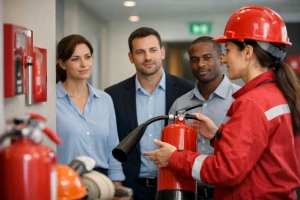
A fire alarm at 10.15 on a wet Tuesday tells you very quickly whether your team has been trained properly or whether they have simply sat through a toolbox talk and signed a sheet. A solid guide to fire safety staff training is not about ticking a compliance box. It is about making sure people know what to do, who leads, where risk sits, and how to respond without delay or confusion.
For employers across Scotland, that means looking beyond a one-size-fits-all session. Fire safety training should reflect the workplace, the people in it, and the level of responsibility different staff hold. An office, a nursery, a workshop, a marina and a forestry site do not present the same hazards, so the training should not be identical either.
Contents
- 1 What fire safety staff training is meant to achieve
- 2 Legal duties and the practical reality
- 3 A guide to fire safety staff training by role
- 4 What good training content should cover
- 5 Choosing the right delivery format
- 6 How often should staff be trained?
- 7 Common mistakes employers make
- 8 Making training work across different sectors
- 9 What to ask before booking training
What fire safety staff training is meant to achieve
At its best, fire safety training gives staff confidence to act sensibly in the early stages of an incident and to evacuate safely when required. It should help employees recognise common causes of fire, understand prevention measures, follow site procedures, and know the limits of their role. That last point matters. Good training does not encourage unnecessary risk. It teaches people when to intervene and when to get out.
For many organisations, there are really two levels to consider. The first is basic fire awareness for the wider workforce. The second is more specific fire marshal or fire warden training for designated personnel who may have added duties during an evacuation, such as sweeping areas, assisting with roll calls or checking escape routes.
That distinction often gets missed. If every employee receives only basic awareness training, managers can assume the site is covered when in fact nobody has been prepared for leadership during an incident. On the other hand, sending a handful of marshals on a course without training the wider team leaves gaps in everyday prevention and evacuation behaviour.
Legal duties and the practical reality
Employers have clear responsibilities under fire safety law, but compliance on paper is only part of the picture. Staff should receive suitable information, instruction and training. In practice, suitable means relevant to the findings of your fire risk assessment, your premises layout, your processes and your workforce.
A low-risk office may need concise, well-structured awareness training with clear evacuation procedures and periodic refreshers. A higher-risk environment such as manufacturing, warehousing, hospitality or construction may need more frequent reinforcement, closer attention to ignition sources and combustible materials, and clearer lines of responsibility.
It also depends on who is on site. Temporary staff, new starters, lone workers, young employees and people who work across multiple locations may all need a more deliberate approach. If a team changes often, annual training alone may not be enough. Induction training becomes just as important as formal scheduled sessions.
A guide to fire safety staff training by role
The most reliable approach is to organise training by role rather than assume the whole business needs the same level of input. Most staff need a clear grounding in prevention, alarm procedures, escape routes, assembly points and reporting arrangements. They should also understand housekeeping standards, safe storage, electrical safety and the dangers of blocked exits or wedged fire doors.
Supervisors and managers usually need more. They may be the people staff turn to first during an evacuation, even if they are not formally appointed as fire marshals. They should understand the site plan, local risks, the needs of visitors and contractors, and what to do if a planned route is unavailable.
Designated fire marshals need focused instruction on their responsibilities. That usually includes human behaviour in fire situations, alarm response, sweep procedures, safe use of firefighting equipment where appropriate, liaising with emergency services and post-incident reporting. The role is not ceremonial. If someone is named as a marshal, they should be properly trained for that function.
What good training content should cover
The detail varies, but most effective courses cover a few core areas. Staff need to understand how fires start, how they spread, and which controls in the workplace reduce the chance of an incident. They also need site-specific procedures rather than generic advice that could apply anywhere.
That means the training should refer to the actual alarm arrangement, escape routes, assembly points, shutdown procedures and reporting lines used on site. If extinguishers are included, the instruction should make clear that using one is only appropriate in limited circumstances and only if the individual has been trained, the fire is small, and there is a safe exit behind them.
This is one area where businesses sometimes get the balance wrong. They either avoid all practical content for fear of liability, or they over-emphasise extinguisher use and give staff the impression they are expected to tackle a fire. Neither is ideal. Training should reinforce life safety first.
Choosing the right delivery format
There is no single best format for every organisation. In-person training remains the strongest option where practical demonstration, role-specific discussion and site layout are important. It allows staff to ask direct questions and gives the trainer a chance to correct assumptions immediately.
On-site delivery can be particularly useful because the training can be tied to the premises itself. Staff can work through real escape routes, call points, assembly areas and local hazards rather than abstract examples. For many employers, this makes the learning more memorable and more operationally useful.
That said, centre-based training can be the better choice where a business wants staff removed from day-to-day distractions or where individuals from different sites need the same accredited instruction. It can also suit smaller employers who do not have enough staff for a private course.
Blended approaches have a place as well. Basic awareness may be delivered efficiently in a classroom session supported by induction material, while appointed marshals complete more in-depth practical training. What matters is not novelty but fit.
How often should staff be trained?
Annual refreshers are common, but they are not always enough on their own. Frequency should follow risk, staff turnover and operational change. If you alter the building layout, bring in new processes, increase occupancy, store different materials or update evacuation arrangements, training should be reviewed straight away.
Refresher training also helps address a familiar problem – people forget. Even where the initial session was strong, details fade over time, especially in lower-risk environments where staff rarely think about fire precautions day to day. Short, regular reinforcement often works better than relying on one session and hoping it sticks.
New starters should never wait months for basic fire instruction. They need fire safety information as part of induction, with fuller training arranged as required. Contractors and agency staff also need clear site rules from the outset.
Common mistakes employers make
The most common issue is treating all workplaces as though they carry the same level of risk. A generic presentation may satisfy nobody if it ignores the actual hazards staff face. Another is failing to define responsibilities clearly. If several people think someone else will check the toilets, close a fire door, call the roll or meet the fire service, that task may not be done at all.
Documentation can be another weak point. Training records matter, especially where employers need to demonstrate compliance, monitor refreshers and show that appointed personnel are competent for their role. But records should reflect genuine training delivered, not just attendance.
There is also a tendency to focus only on the scheduled course and forget the wider system. Training works best when it sits alongside a current fire risk assessment, regular drills, maintained equipment and clear internal communication. If one of those pieces is missing, the value of the training drops.
Making training work across different sectors
Sector context changes the emphasis. In childcare or education settings, evacuation management and the safe movement of dependants become central. In construction, temporary layouts, changing access routes and hot works may need more attention. In hospitality, public interaction, busy service periods and sleeping accommodation can complicate response. In marine or outdoor settings, location and emergency access may shape procedures more than the building itself.
That is why bespoke delivery often produces better results than standardised content alone. A provider with experience across workplace safety, emergency response and regulated instruction can usually tailor the session to the realities of the site without losing sight of the legal baseline.
For Scottish employers with varied teams and locations, flexibility matters as much as accreditation. Training needs to be credible, practical and straightforward to arrange. Providers such as SPR Training support that by delivering recognised fire safety instruction either at a training centre or on client premises across Scotland, allowing businesses to match delivery to their operation.
What to ask before booking training
Before committing to a course, employers should be clear about who needs training, what role they perform, what risks exist on site and whether the content is awareness-based or marshal-level. It is also worth asking how much of the session is tailored to your workplace, whether practical elements are included, and what evidence of completion staff will receive.
If the answer to every training need is the same standard course, it is worth pausing. Consistency is useful, but fire safety is rarely identical from one site to another. The right course should be suitable for the environment and proportionate to the responsibilities involved.
The strongest fire safety training leaves staff with a clear sense of what they must do, what they must not do, and how their actions fit into the wider emergency plan. When that is in place, training stops being a paper exercise and starts doing the job it is there to do.