
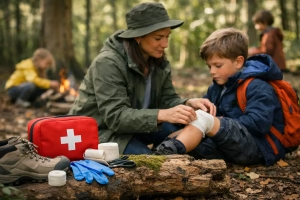
A child slips on wet ground, catches a forearm on a hidden branch, and suddenly a calm woodland session becomes a first aid incident. That is exactly why a clear guide to forest school first aid matters. In outdoor learning, distance, terrain, tools, weather and delayed ambulance access can all change how you assess risk and respond.
Forest school first aid is not simply indoor first aid moved outside. The principles are the same, but the environment changes the pace, priorities and practical demands. Leaders need to manage common injuries such as cuts, splinters, sprains and minor burns, while staying prepared for more serious incidents including significant bleeding, head injury, asthma, allergic reaction, hypothermia and medical emergencies where evacuation may be slower.
Contents
- 1 What makes forest school first aid different?
- 2 A guide to forest school first aid risk factors
- 3 Planning matters as much as treatment
- 4 What should be in a forest school first aid kit?
- 5 Training should reflect the environment
- 6 Responding well when an incident happens
- 7 Common judgement calls in woodland sessions
- 8 Building a safer forest school operation
What makes forest school first aid different?
The main difference is context. In a nursery, classroom or sports hall, you are likely to have easier access to shelter, lighting, running water, communication and emergency services. In woodland or rural outdoor sites, those things may be limited or absent. Even a minor injury can become harder to manage if the ground is uneven, the weather turns, or your casualty is a ten-minute walk from the nearest vehicle access point.
This means first aiders in forest school settings must think beyond the immediate treatment. They also need to consider supervision of the wider group, safe use of tools, manual handling over difficult ground, casualty movement, communication with parents or carers, and access for emergency responders. The first aid response sits inside a wider incident management process.
For that reason, a standard workplace or paediatric course may not always be enough on its own. It depends on your site, your learners, your activities and the level of risk you routinely manage.
A guide to forest school first aid risk factors
Any useful guide to forest school first aid starts with the hazards most likely to affect treatment decisions. Woodland sessions often include fire lighting, tool work, den building, rope use and exploration over natural terrain. Each activity carries its own injury profile.
Cuts and grazes are common, particularly where learners handle sticks, saws or natural materials. Sprains and strains happen on slopes, roots and muddy pathways. Burns may result from Kelly kettles, campfires or hot cooking equipment. Stings, bites and plant exposure can lead to local irritation or, in some cases, severe allergic reaction. Exposure is another issue. A wet child in cold conditions can deteriorate quickly, even after what first appeared to be a minor incident.
There is also the human factor. Many forest school groups include younger children, pupils with additional support needs, or participants who may struggle to explain pain, symptoms or mechanism of injury. A good first aider must work with incomplete information and stay systematic.
Planning matters as much as treatment
Strong outcomes usually start before the session begins. The best forest school providers do not rely on the kit bag alone. They plan for likely incidents, site constraints and the practical reality of getting help.
A suitable first aid plan should match the location and the group. That includes checking access points, grid references or postcode alternatives, mobile signal strength, nearest defibrillator availability, weather conditions and any restrictions on vehicle access. If the site is remote, your response arrangements may need to be more self-sufficient than they would be in a town park.
Medical information also needs proper attention. Leaders should know about allergies, asthma, diabetes, epilepsy and prescribed medication relevant to the group. In paediatric settings, consent procedures and clear emergency contact details are essential. None of this is paperwork for its own sake. It directly affects speed and quality of care when something goes wrong.
What should be in a forest school first aid kit?
The right kit depends on your activity and the age of your participants, but it should reflect woodland risks rather than a generic office stock list. You need supplies for bleeding control, burns, eye contamination, minor wounds and environmental exposure, while also keeping the kit portable and weather-resistant.
A practical setup often includes plasters, sterile dressings, bandages, cleansing materials, gloves, eye wash, burns dressings or gel, a foil blanket, trauma dressings and a means of recording treatment. Depending on your operating model, you may also carry tick removers, shears, resuscitation barrier devices and additional supplies for longer incidents. If prescription medicines such as inhalers or auto-injectors are part of a participant care plan, staff must understand the site policy and their level of training.
There is a balance to strike. An overfilled bag can be awkward to transport across rough ground, but an underprepared kit can leave you exposed. The answer is not to carry everything. It is to carry what your risk assessment supports and to check it routinely.
Training should reflect the environment
This is where many organisations fall short. They appoint a first aider, tick the box, and assume the requirement is covered. In practice, the right course should reflect both the legal context and the outdoor setting.
If you work with children, paediatric content may be necessary. If your activities include woodland tools, fire and off-grid locations, outdoor-specific first aid content becomes highly relevant. If your staff may have to deal with catastrophic bleeding, prolonged casualty care or delayed handover, a more advanced level of training may be appropriate.
It is rarely a one-size-fits-all decision. A primary school using a managed green space for short sessions has different needs from an independent forest school leader running full-day programmes in remote woodland. Employers and providers should look at learner age, staff ratios, travel time to emergency care, activity type and previous incident history before choosing training.
For many Scottish providers, the most sensible option is accredited, scenario-based training that reflects real operating conditions rather than purely classroom examples. That is where specialist outdoor first aid instruction adds value. Providers such as SPR Training deliver practical, compliance-led courses designed around workplace and sector risk rather than generic theory.
Responding well when an incident happens
A calm response depends on a simple structure. First, make the area safe. A casualty beside a fire, tool area or unstable branch pile may need scene control before treatment begins. Next, assess the casualty using a clear primary survey. If the issue is life-threatening, act quickly and call for emergency assistance early.
In forest school settings, delegation matters. One competent adult may treat the casualty while another supervises the group, clears access for emergency services or meets responders at a gate. This is often harder than the treatment itself, especially with younger children who may be distressed or curious.
For non-life-threatening injuries, treatment still needs to be methodical. Clean and dress wounds properly, monitor for change, and consider whether the participant can safely remain on site. A child with a minor graze may continue. A child with a worsening limp, signs of concussion or burn injury should not. Good judgement is part of first aid.
Documentation matters too. Record what happened, what treatment was given, timings, and whether escalation was required. In a school or organised setting, this supports safeguarding, follow-up and review of risk controls.
Common judgement calls in woodland sessions
The difficult cases are not always dramatic. They are the ones that sit in the middle ground. A bumped head with no immediate symptoms may still need close observation. A sting may look minor but become more serious if swelling spreads or breathing changes. A child who is cold, quiet and reluctant to join in may be developing exposure rather than simply feeling tired.
This is why forest school first aid relies heavily on observation and reassessment. The condition you see at first contact is not always the condition you are managing ten minutes later. Staff need the confidence to step up their response when the picture changes.
It also helps to avoid false reassurance. Parents, carers and settings appreciate clear, factual communication. Saying that an injury seems minor is reasonable if it is based on assessment and monitoring. Saying everything is fine too early can create risk.
Building a safer forest school operation
First aid is only one part of the control system, but it influences the whole standard of delivery. When staff are properly trained, kits are fit for purpose and emergency arrangements are rehearsed, the wider session tends to run better. People make clearer decisions. Near misses are taken seriously. Risk assessments become more than paperwork.
There is also a professional credibility point here. Schools, parents, local authorities and partner organisations increasingly expect outdoor providers to show that their safety arrangements are specific to the environment they work in. A generic approach is less convincing, and in some cases less defensible, than a forest school model built around actual hazards and access issues.
If you run outdoor sessions, review your current first aid provision honestly. Check whether your training matches your activities, whether your emergency plan works in poor weather, and whether your team could manage a serious incident before ambulance crews arrive. That kind of preparation is not excessive. It is what safe, competent forest school practice looks like.
The woodland should feel adventurous, not uncertain – and good first aid planning is one of the reasons it can.