
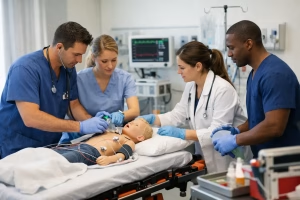
When a child becomes seriously unwell or injured, the first few minutes are rarely calm. In a nursery room, on a sports pitch, at a holiday club or during transport, adults have to assess quickly, act within their training and keep the wider group safe at the same time. That is exactly why a clear guide to emergency paediatric response matters – not as theory, but as a practical framework for making sound decisions under pressure.
Paediatric emergencies are not simply smaller versions of adult incidents. Children compensate differently, deteriorate faster in some circumstances, and may be unable to describe what they feel. Their normal observations vary with age, their airway anatomy is different, and distress itself can make assessment harder. For employers, childcare settings and activity providers, the right response depends on both first aid competence and a working understanding of safeguarding, escalation and handover.
Contents
- 1 What emergency paediatric response actually covers
- 2 A guide to emergency paediatric response in real settings
- 3 Why children can deteriorate quickly
- 4 The role of communication during an incident
- 5 Common emergency presentations and where judgement matters
- 6 Training, refreshers and sector-specific planning
- 7 Building a stronger response before an emergency happens
What emergency paediatric response actually covers
Emergency paediatric response is the immediate action taken when an infant or child is injured or suddenly unwell. That can include choking, unresponsiveness, breathing difficulties, seizures, major bleeding, burns, allergic reactions, head injury or signs of serious infection. In practice, the response starts before treatment. It begins with scene safety, rapid recognition, and deciding whether the situation can be managed on site or needs urgent ambulance support.
For trained staff, the process should be structured rather than improvised. A calm, methodical approach reduces errors and helps the child, colleagues and parents feel more secure. In regulated environments such as nurseries, schools, clubs and some healthcare or leisure settings, there is also a compliance duty. Staff need to be able to show that emergency planning, training and record keeping match the risks they actually face.
A guide to emergency paediatric response in real settings
Most incidents do not happen in ideal conditions. You may be managing a distressed infant while other children are watching. You may be outdoors with limited kit, or waiting for emergency services in a rural area. Because of that, a useful guide to emergency paediatric response has to work across different sectors, not just in a classroom scenario.
The first priority is always danger. Check the environment before you approach. A child on a playground surface, near water, beside traffic or close to equipment may need the area controlled before care can begin. Staff safety is part of patient safety. If a responder becomes another casualty, the situation worsens quickly.
The second priority is the child’s basic condition. Are they responsive? Are they breathing normally? Is there catastrophic bleeding? These are the questions that shape the first actions. For an unresponsive child with absent or abnormal breathing, resuscitation and urgent ambulance activation are central. For severe bleeding, immediate pressure and bleed control come first. For choking, the response depends on whether the obstruction is mild or severe and whether the child is still conscious.
After that initial picture, the role of observation becomes more important. Skin colour, work of breathing, level of alertness, posture, crying, temperature and any rapid change in behaviour all matter. Children often show deterioration through subtle signs before a full collapse. Quietness in a normally active child, reduced interaction, poor muscle tone or increasing effort to breathe can be more significant than dramatic symptoms.
Why children can deteriorate quickly
Adults sometimes assume that a child who is still awake is stable. That is not always the case. Children often maintain compensation for a period and then decline rapidly. A fast heart rate, rapid breathing or increasing tiredness may be the body trying to cope before it can no longer do so.
Airway problems are a common example. Swelling, mucus, an inhaled object or poor positioning can compromise a child’s airway more quickly than in an adult. Likewise, dehydration, fever and infection can escalate fast in infants and younger children. This is why paediatric first aid training places such emphasis on early recognition and prompt escalation rather than waiting to see whether things settle.
It also means that confidence must be matched with caution. Not every bump to the head requires blue-light attendance, and not every fever is an emergency. But where breathing is affected, responsiveness is altered, a seizure is prolonged, bleeding is severe, or a child is becoming increasingly drowsy, delayed action carries real risk.
The role of communication during an incident
Clinical skill is only one part of the response. Communication has a direct effect on outcome. One person should take the lead if possible, giving clear instructions to colleagues: call 999, fetch the first aid kit, meet the ambulance crew, supervise the other children, contact parents. That reduces duplication and confusion.
With the child, language should be simple and reassuring. A frightened child may resist assessment, particularly if they are in pain or surrounded by unfamiliar adults. Tone matters. Short, calm instructions are more useful than repeated questioning.
Parents and carers need accurate information, not guesswork. Tell them what happened, what signs were seen, what treatment was given and whether emergency services were called. If the incident takes place in a workplace or regulated setting, documentation should be completed promptly and factually. Record times, observations, interventions and who was informed. These records support continuity of care and protect both the child and the organisation.
Common emergency presentations and where judgement matters
Some paediatric emergencies are obvious. An unresponsive infant, a child with severe breathing difficulty or major bleeding requires immediate action. Others involve more judgement.
Head injuries are a good example. A minor bump with a quick recovery may only need observation and parental advice. A child who vomits repeatedly, becomes drowsy, behaves unusually or has a seizure after a head injury needs more urgent assessment. The same principle applies to allergic reactions. Mild skin symptoms can progress, and any involvement of the airway or breathing changes the urgency immediately.
Burns and scalds are also often underestimated, particularly in younger children. The burn may look manageable at first, but depth, location and total area all affect risk. Hands, face, airway, genitals and large surface areas require particular care. Cooling the burn appropriately is important, but so is recognising when hospital treatment is needed.
Seizures present another area where setting matters. A child with a known history and a brief, self-limiting seizure may have an established care plan. A first seizure, a prolonged seizure, injury during the event, or poor recovery afterwards should be treated more cautiously. The difference between a known condition and an unknown cause matters, but it should never be used as a reason to delay escalation.
Training, refreshers and sector-specific planning
A certificate on its own is not the same as readiness. Skills fade, especially those used infrequently. That is why refresher training and scenario-based practice are so valuable for staff working with children. The most effective teams rehearse the practical realities of their own setting – where the kit is kept, who calls emergency services, how access is gained for ambulance crews, who manages the remaining children, and how handover is delivered.
Different sectors also face different risks. A nursery may focus more on choking, febrile seizures, allergic reactions and falls. A sports club may see more fractures, asthma issues, head injuries and environmental exposure. Outdoor learning providers need to consider delayed access to definitive care, while transport and community settings may have limited space and fewer staff on hand. The response principles remain the same, but the planning should reflect the environment.
For organisations across Scotland, this is where accredited training has practical value. It helps ensure staff are not only compliant on paper but capable in the situations they are likely to encounter. Providers such as SPR Training build that operational focus into delivery, which is particularly useful for employers who need training aligned to real workplace risk rather than generic content.
Building a stronger response before an emergency happens
Emergency paediatric response starts long before an incident. It is shaped by policies, staff ratios, medical information, consent processes, incident reporting systems and the condition of first aid equipment. If inhalers, auto-injectors or emergency contact details are not accessible, even a well-trained responder is working at a disadvantage.
Good preparation also includes recognising limits. First aid is immediate care, not diagnosis. Staff should be confident enough to act and disciplined enough to escalate when the picture is unclear or worsening. That balance matters. Overreaction can create unnecessary disruption, but underreaction can place a child at avoidable risk.
The strongest teams are usually the ones with a simple system, current training and a shared understanding of who does what. In paediatric emergencies, those basics make a substantial difference. When the environment is busy, the child is distressed and the pressure is high, clear actions and current skills are what carry the response forward.
If your role involves caring for children, supervising activities or managing staff in child-centred settings, treating emergency preparedness as a live operational requirement is the sensible approach. The child in front of you does not need perfect conditions. They need competent, timely care from adults who know what to do next.