
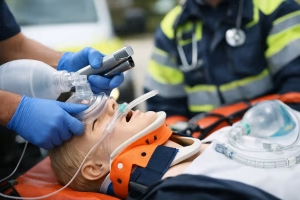
A deteriorating airway rarely announces itself neatly. A patient may be talking but tiring, vomiting, snoring, confused, or becoming less responsive. An airway management CPD update gives experienced responders time to revisit the assessments and practical interventions that matter when those changes happen quickly.
For workplace first aiders, event responders and pre-hospital practitioners, the purpose is not simply to repeat a skill. It is to refresh safe decision-making, practise hands-on techniques and confirm when a patient needs escalation rather than further intervention. The right update depends on role, current competence, equipment carried and the clinical governance that applies to the organisation.
Contents
Why an airway management CPD update matters
Airway skills can deteriorate when they are not used regularly. This is particularly relevant for responders who may hold a first responder or emergency care qualification but encounter serious airway compromise only occasionally. Knowledge of an airway manoeuvre is not the same as recognising when to use it, applying it effectively under pressure and reassessing the patient afterwards.
A structured CPD session creates a controlled setting in which learners can revisit that process. Practical scenarios can include an unconscious casualty, suspected opioid overdose, trauma with altered consciousness, vomiting and airway contamination, or a patient whose condition worsens while waiting for ambulance support. Each situation requires observation, prioritisation and clear communication, not just a memorised sequence.
For employers, there is also a governance benefit. Specialist CPD demonstrates that designated responders are maintaining skills relevant to the risks they may reasonably face. It should sit alongside, rather than replace, appropriate initial qualifications, risk assessment, equipment checks and emergency procedures.
What should practical airway CPD cover?
The most useful sessions focus on assessment, intervention and reassessment. Learners should be able to identify signs of partial or complete obstruction, reduced airway tone, ineffective breathing and aspiration risk. They should also understand how a patient’s presentation can change following trauma, seizure activity, intoxication or medical illness.
Assessment before intervention
Good airway management starts with a rapid, structured patient assessment. Is the patient able to speak? Is there snoring, gurgling, stridor or silence? Are they maintaining their own airway? What is their level of response, respiratory effort and skin colour? These observations guide the next action and provide valuable information to ambulance crews.
Positioning is often the first practical intervention. A simple head tilt and chin lift may improve airway patency for an unresponsive patient when trauma is not suspected. Where spinal injury is a concern, responders need to work within their training and local protocols, using an approach that protects the airway while minimising unnecessary movement.
The update should reinforce the value of ongoing reassessment. An airway that is clear at the start of an incident may not remain clear. Fatigue, secretions, blood, vomit and a declining level of consciousness can all alter the priorities.
Airway manoeuvres and recovery positions
Basic manoeuvres must be practised until they are purposeful rather than automatic. Learners should consider the patient’s condition, body position and likely mechanism of injury before acting. They should also know when the recovery position is appropriate and how to monitor a patient once positioned.
In real incidents, access may be limited by confined spaces, heavy clothing, sporting equipment or the environment. A training room session is valuable, but scenarios that reflect the workplace or event setting are often more effective. A forestry team, for example, may have different access and communication challenges from a gym, nursery or office-based team.
Suction, adjuncts and oxygen
The equipment element of an airway management CPD update should always reflect the learner’s scope of practice and the equipment available to them. This may include safe use of suction, oxygen equipment and basic airway adjuncts where these are authorised within the relevant role, training framework and clinical governance arrangements.
Adjunct selection is not about choosing the most advanced item in the kit. It is about recognising when a simple intervention is indicated, checking for contraindications, using the correct size and monitoring its effect. Learners should understand that an adjunct does not remove the need for observation, ventilation support where indicated, or early escalation.
Oxygen administration also needs context. Responders should know how to prepare equipment, apply an appropriate delivery device, observe the patient and document what has been given. The precise approach should follow current guidance, organisational policy and the responder’s qualification. A CPD update is an ideal opportunity to identify equipment that has changed, expired consumables or gaps in local procedures.
Ventilation and escalation
When a patient is not breathing normally, effective ventilation and rapid activation of emergency services are critical. Practical training can refresh mask seal, airway positioning, use of a bag-valve-mask where within scope, and team communication during resuscitation. These skills require practice because poor positioning, an ineffective seal or delayed reassessment can reduce the benefit of the intervention.
Responders must also recognise the limits of what they can safely manage. Persistent obstruction, facial or neck trauma, burns, severe allergic reaction, suspected inhalation injury and rapidly worsening consciousness require urgent escalation. The aim is to provide appropriate immediate care, collect useful observations and hand over clearly to arriving clinicians.
Matching the update to the responder role
Not every learner needs the same depth of airway training. A workplace first aider may need a strong grounding in basic airway opening, recovery position, CPR, use of an AED and calling for help. A responder working at events or in a community first responder role may require more exposure to suction, oxygen, adjuncts and structured handover, depending on their governance arrangements.
For healthcare, pre-hospital and specialist operational teams, an update may need to address more advanced equipment, team roles and scenario-based decision-making. In these settings, training should be aligned with the individual’s existing qualification, employer policy and the expected clinical environment.
This distinction matters. Training beyond a person’s role can create uncertainty, while training that is too basic may not prepare an experienced responder for the risks they are expected to manage. A provider should establish the learners’ current certification, practice setting and available equipment before designing the session.
What employers should review alongside CPD
Training has greater value when it is supported by practical readiness. Employers arranging airway-related CPD should review whether their emergency plan is workable at the point of need. This includes the location and condition of kits, who can access them, how emergency services will be directed to the site and how incidents are recorded.
Consider the response time and work environment. A remote site, busy construction project, sports venue or marine setting may need a different plan from a small office. Noise, poor mobile signal, distance from vehicle access and the presence of hazardous machinery can all influence how a casualty is managed before further help arrives.
It is also sensible to check staff confidence. Some people have completed a qualification but have not handled suction equipment, assembled an oxygen cylinder or practised a team airway scenario for some time. A focused CPD session can identify these issues before an emergency exposes them.
Making the learning practical
The best airway updates allow learners to make decisions, not simply watch a demonstration. Short, realistic scenarios give participants the chance to assess a casualty, choose an intervention, communicate with colleagues and respond when the patient’s condition changes. Constructive feedback then links the practical activity back to clinical reasoning and local procedure.
For private groups, tailoring makes a difference. Training delivered for a nursery, outdoor instructor team, gym staff or industrial workforce should use situations that feel recognisable to those learners. The core principles remain consistent, but the likely hazards, available equipment and route to emergency care vary considerably.
At SPR Training, specialist CPD can be planned around the team’s existing qualifications and operational requirements, helping organisations keep learning relevant rather than treating refresher training as a box-ticking exercise.
Keeping airway skills current
There is no single refresher interval that suits every responder. The appropriate frequency depends on qualification requirements, employer policy, exposure to risk, local governance and how often skills are used. Teams with specialist equipment or remote operating conditions may benefit from more frequent practical practice than staff working in lower-risk settings.
A useful approach is to combine formal CPD with brief internal checks. Equipment familiarisation, scenario discussion and review of an actual incident can all reinforce learning between courses. These activities should not be presented as a substitute for accredited training where that is required, but they can help keep procedures familiar.
An airway emergency gives little time to search for equipment or recall a technique. A well-planned update helps responders recognise the problem early, use the skills they are trained and authorised to deliver, and call for the right support without delay. That confidence is built through relevant practice, clear boundaries and a response plan that works in the real world.