
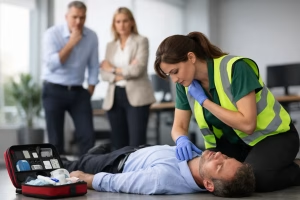
A workplace with ten desk-based staff does not need the same first aid provision as a forestry team using chainsaws or a yard handling heavy plant. That is why the question of who needs EFAW training matters. Emergency First Aid at Work is designed for lower-risk settings, but the right answer always starts with your first aid needs assessment, not a guess.
EFAW stands for Emergency First Aid at Work. It is a one-day course that gives learners the skills to deal with a range of common workplace emergencies until further help arrives. In practice, that usually means dealing with an unresponsive casualty, CPR, use of an AED, choking, bleeding, shock and minor injuries. It is a practical qualification, and for many Scottish employers it is the most proportionate option – but not for all.
Contents
Who needs EFAW training?
EFAW training is typically suitable for people working in low-hazard environments where the first aid needs assessment shows that emergency-level cover is enough. That often includes offices, shops, libraries, reception teams, community venues, small retail units and similar workplaces where serious trauma is less likely and emergency services are reasonably accessible.
It can also suit individual staff members who have been nominated as appointed first aiders in smaller organisations. If your business has identified that it needs a trained person on site to provide immediate assistance for incidents such as collapses, cuts, burns, fainting, seizures or choking, EFAW may be the right level.
The key point is that EFAW is about immediate response. It is not the same as full First Aid at Work, which covers a broader range of conditions and is usually expected in higher-risk workplaces or where there are larger teams, more complex hazards or longer waits for emergency support.
The roles and workplaces where EFAW often fits
In straightforward office environments, EFAW is commonly enough. Staff are generally exposed to slips, trips, minor cuts, occasional burns from kitchen areas and medical emergencies unrelated to the work itself. In those settings, having one or more EFAW-trained first aiders can meet the employer’s duty, provided the numbers and cover pattern are right.
Retail and hospitality can also fall into the EFAW category, depending on the site. A small shop with predictable footfall has different risks from a large venue with late trading, lone workers and regular incidents involving the public. The course can be suitable, but only where the assessment supports it.
Community groups, places of worship, charities and voluntary organisations often find EFAW useful as well. These settings may not be legally identical to every workplace, but the practical need is similar – someone should know what to do in the first few critical minutes.
Schools, nurseries and childcare settings are a different matter. They may need paediatric first aid rather than, or in addition to, EFAW. Sports coaches, outdoor instructors and equestrian professionals may also need more specialist provision because the activity itself changes the risk profile.
When EFAW is not enough
Some employers ask who needs EFAW training when the better question is whether EFAW is enough for their environment at all. If your staff work with machinery, tools, electricity, hazardous substances, livestock, heat processes, vehicles or members of the public in volatile situations, a one-day emergency course may not provide sufficient depth.
Construction is an obvious example. Even on smaller sites, there is a greater likelihood of crush injuries, falls, serious bleeding and fractures. Manufacturing, warehousing, engineering, agriculture and forestry also tend to sit beyond the scope of basic emergency first aid cover. In these sectors, the first aid needs assessment often points towards First Aid at Work, additional trauma content or sector-specific enhancement.
Remote and rural work creates another complication. A low-hazard task in a city office is one thing. The same task carried out miles from prompt ambulance attendance is something else. Travel time for emergency services, poor mobile signal, weather conditions and site access all affect what level of training is sensible.
This is where employers sometimes under-specify. They look at the job title rather than the actual working conditions. A maintenance worker on paper may seem low risk compared with a construction operative, but if that person works alone across dispersed sites, the first aid arrangements need closer thought.
Legal duties and the role of the first aid needs assessment
Under the Health and Safety (First-Aid) Regulations 1981, employers must provide adequate and appropriate equipment, facilities and personnel so employees can receive immediate attention if they are injured or taken ill at work. The phrase that matters is adequate and appropriate. There is no single course that fits every business.
Your first aid needs assessment should consider the nature of the work, the hazards present, workforce size, shift patterns, history of incidents, lone working, distance from emergency medical help and whether the public are present. It should also look at practical issues such as annual leave and sickness cover. One trained person is not enough if they are often off site.
EFAW is often chosen because it is efficient, proportionate and easier to roll out across multiple staff. That can be a sound decision. It becomes a poor one only when the qualification is selected for convenience rather than risk.
Who should be selected for EFAW training?
Once you have decided that Emergency First Aid at Work is the right level, the next step is choosing the right people. Reliable attendance matters. There is little value in training someone who rarely works on site or who cannot realistically respond when needed.
Good candidates are staff who are calm under pressure, present during core operating hours and willing to take responsibility. In smaller businesses that may be an office manager, supervisor or team leader. In customer-facing settings it may be front-of-house staff, duty managers or venue supervisors. Across shift-based operations, you may need coverage in every department and on every rota pattern.
It also helps to think about layout. If your premises are spread across more than one floor, building or work area, first aiders should be positioned so they can reach an incident quickly. The number trained is not just about headcount. It is about access and response time.
EFAW compared with First Aid at Work
EFAW covers the essentials for dealing with life-threatening situations and a small range of common injuries. First Aid at Work goes further. It is more detailed, lasts longer and prepares learners for a wider range of workplace incidents.
For many low-risk businesses, EFAW is a sensible and compliant option. For higher-risk employers, it may form part of the picture but not the whole answer. Some organisations train several staff in EFAW and then nominate one or two people to complete the fuller First Aid at Work qualification. That blended approach can work well where risk varies across teams.
There are also settings where neither standard workplace route is the best fit on its own. Childcare providers may need paediatric first aid. Outdoor leaders may require outdoor-specific content. Healthcare and fitness professionals may need basic life support or role-specific updates. Choosing the right qualification is less about labels and more about matching training to foreseeable incidents.
A practical way to decide
If you are unsure who needs EFAW training in your organisation, start with three questions. First, what could realistically happen here? Secondly, how quickly would professional help reach us? Thirdly, who is actually available to respond when something goes wrong?
If the answers point to lower-level hazards, quick access to emergency services and a manageable workforce, EFAW is often appropriate. If the risks are more severe, more varied or more remote, you are likely looking at a higher or more specialised standard.
For employers across Scotland, this is usually easiest to get right when the training decision is tied directly to the workplace assessment rather than copied from another business. A salon, a boat club, a warehouse and a nursery may all need first aid provision, but they do not need identical training.
The most useful first aid qualification is the one that matches the real world your staff work in. Get that right, and training stops being a box-ticking exercise and starts becoming part of how your organisation looks after its people.