
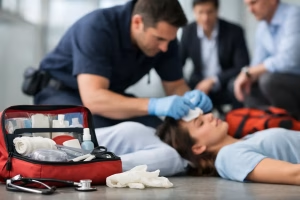
A first aid certificate on the wall does not, by itself, make a workplace compliant. What matters is whether your arrangements match the risks people actually face. This guide to emergency first aid regulations is intended to help employers, managers and responsible persons across Scotland understand what the law expects, where judgement is required, and how to choose training that stands up in practice.
Contents
- 1 What emergency first aid regulations actually require
- 2 The guide to emergency first aid regulations starts with risk
- 3 Emergency First Aid at Work is one option, not the whole answer
- 4 Who needs to be trained
- 5 Equipment, facilities and records
- 6 Refresher training and skills fade
- 7 Sector-specific rules and guidance can sit alongside general regulations
- 8 Choosing a training provider
- 9 Common compliance mistakes
What emergency first aid regulations actually require
In most workplaces, the starting point is the Health and Safety (First-Aid) Regulations 1981. These regulations require employers to provide adequate and appropriate equipment, facilities and personnel so employees can receive immediate attention if they are injured or taken ill at work. That sounds straightforward, but the phrase adequate and appropriate is where most of the real decision-making sits.
The law does not apply as a simple one-size-fits-all rule. A quiet office, a busy warehouse, a construction site, a nursery and a forestry team working remotely will not need the same first aid provision. The regulations set the duty. Your first aid needs assessment determines what that duty looks like in your setting.
For many lower-risk workplaces, Emergency First Aid at Work training may form part of a suitable arrangement. For higher-risk environments, larger teams, remote working conditions or businesses with specific hazards, a fuller First Aid at Work provision may be more appropriate. In some sectors, that still may not be enough.
The guide to emergency first aid regulations starts with risk
If you want to get this right, start with the hazards, not the course brochure. Your needs assessment should consider the nature of the work, the level of risk, workforce size, shift patterns, public access, lone working and how quickly emergency services could realistically attend.
A low-risk premises with a small number of staff and rapid ambulance access may be well served by a modest but properly managed first aid arrangement. A site with machinery, vehicles, heat, chemicals, sharp tools, members of the public or work in remote areas needs more depth. The same applies where there are known medical conditions in the workforce or a pattern of incidents that suggests higher demand.
This is where employers can come unstuck. They sometimes ask, “What is the minimum course we can book?” The better question is, “What level of trained response do our risks justify?” Compliance is not just about buying training. It is about being able to defend the decision behind it.
Adequate and appropriate means proportionate
Proportionate does not mean minimal. It means matched to need. In practical terms, that usually includes trained first aiders, suitable first aid kits, clear arrangements for contacting emergency services, accident reporting processes and cover for absence or annual leave.
If one appointed person or one trained first aider is always off site, on break or tied to a fixed area, your provision may look fine on paper but fail in reality. Regulations are met through availability, not assumptions.
Emergency First Aid at Work is one option, not the whole answer
Emergency First Aid at Work, often delivered as a one-day qualification, is designed for lower-risk environments or to support a wider first aid structure. It commonly covers incident assessment, CPR, use of an AED, choking, bleeding, shock and some common minor injuries. For many businesses, that is a useful baseline.
It is not automatically suitable for every workplace. If your team faces more significant injury risks, works with children, operates in outdoor settings, provides care, or could have delayed access to emergency services, a different or additional qualification may be needed. Paediatric settings, sports environments, construction, marine activity and pre-hospital roles each bring their own training expectations.
That is why course titles should never be treated as a shortcut for compliance. The right question is whether the content, duration and certification align with the hazards and responsibilities in your setting.
Who needs to be trained
The regulations do not set a universal fixed number of first aiders for every business. Numbers should come from your assessment. A small office may only need limited cover. A factory operating across shifts may need several first aiders to ensure there is always competent help available. Sites with spread-out teams, separate floors or outdoor work zones often need more coverage than headcount alone would suggest.
You should also think beyond employees. If members of the public, contractors, learners, clients or visitors are regularly on site, they should feature in your planning. The legal duty focuses on employees, but sensible first aid arrangements rarely stop there.
For employers with mobile teams or staff travelling across Scotland, local access matters too. A trained first aider based at head office is of limited use to a technician two hours away on a client site.
Appointed persons are not the same as first aiders
Some workplaces name an appointed person to take charge of first aid arrangements, call the emergency services and look after equipment. That role has value, but it is not a substitute for trained first aid cover where the risk assessment shows training is needed.
This distinction matters. Appointing someone to manage the kit does not mean they are competent to assess and treat a casualty.
Equipment, facilities and records
Training is only one part of compliance. The regulations also require suitable first aid equipment and, where appropriate, facilities. The contents of a first aid kit should reflect the hazards identified in your assessment. A generic box may be enough in one setting and plainly inadequate in another.
Where there are higher risks of severe bleeding, burns or crush injuries, your provision may need to go well beyond basic plasters and dressings. The same principle applies to welfare facilities. Larger or higher-risk sites may need a dedicated first aid room or clearly defined treatment area.
Records matter as well. While there is no blanket legal rule requiring every minor incident to be logged in the same way, maintaining accurate records is good practice and often essential for internal review, insurance and reporting obligations. You should also keep training records, certificate dates, refresher schedules and inspection logs for kits and AEDs.
Refresher training and skills fade
One of the weaker points in many first aid systems is what happens after the initial course. Certificates have validity periods, but practical ability can decline well before renewal is due. CPR, AED use, casualty assessment and bleeding control are all skills that benefit from regular refreshers.
A business that trained its staff three years ago and has not revisited scenarios since may still hold paperwork, but confidence and competence can be another matter. In operational terms, that gap matters. A compliant arrangement should be credible on the day it is needed, not only on the day it was booked.
For higher-risk teams or those with sector-specific hazards, short update sessions and scenario-based practice are often worthwhile. They help staff retain the actions that matter in the first few minutes of an incident.
Sector-specific rules and guidance can sit alongside general regulations
A general workplace first aid course is not always enough. Some industries have additional guidance, client expectations, licensing conditions or awarding body standards that affect what is suitable. Childcare providers may need paediatric first aid. Outdoor instructors and forestry teams may require training that reflects delayed help and environmental factors. Sports coaches, event staff and marine personnel often need provision shaped by their operating context.
This is where employers need to avoid a common mistake. Meeting the basic workplace regulation does not automatically mean you have met sector expectations. If your insurers, governing body, contract conditions or internal risk profile demand more, that becomes the practical benchmark.
For Scottish organisations with mixed teams, the most effective approach is often a layered one. Office staff may need one level of provision, operational crews another, and specialist personnel additional modules such as oxygen administration, catastrophic bleeding control or outdoor casualty management.
Choosing a training provider
When selecting training, accreditation and relevance matter. The course should be recognised, current and delivered by trainers who understand the environment your staff work in. A compliant certificate is important, but so is the quality of the teaching and the realism of the scenarios.
A provider should be able to explain why a course fits your risk profile, not simply sell the nearest option. They should also be clear about course duration, certification, renewal periods and any sector-specific limitations. For organisations across Scotland, on-site delivery can be a practical advantage, especially where travel, shifts or team size make open courses less efficient. Providers such as SPR Training also support businesses that need a combination of workplace, paediatric, outdoor or specialist first aid provision rather than a single standard package.
Common compliance mistakes
Most problems arise from underestimating risk, over-relying on the minimum, or failing to review arrangements as the business changes. A company may move premises, increase staff numbers, add machinery, extend operating hours or take on public-facing work without updating its first aid needs assessment.
Another common issue is assuming that one trained person covers all circumstances. If they leave, change roles or are frequently absent, your arrangement can quickly become inadequate. Equally, buying specialist kit without training staff to use it creates a false sense of readiness.
The best first aid systems are not complicated. They are matched to risk, documented properly, reviewed regularly and supported by training that people can actually apply under pressure.
If you are reviewing your own arrangements, the useful test is simple: if someone collapsed or was seriously injured in your workplace this afternoon, would the nearest response be competent, equipped and immediate? If the answer is uncertain, that is where your next action sits.